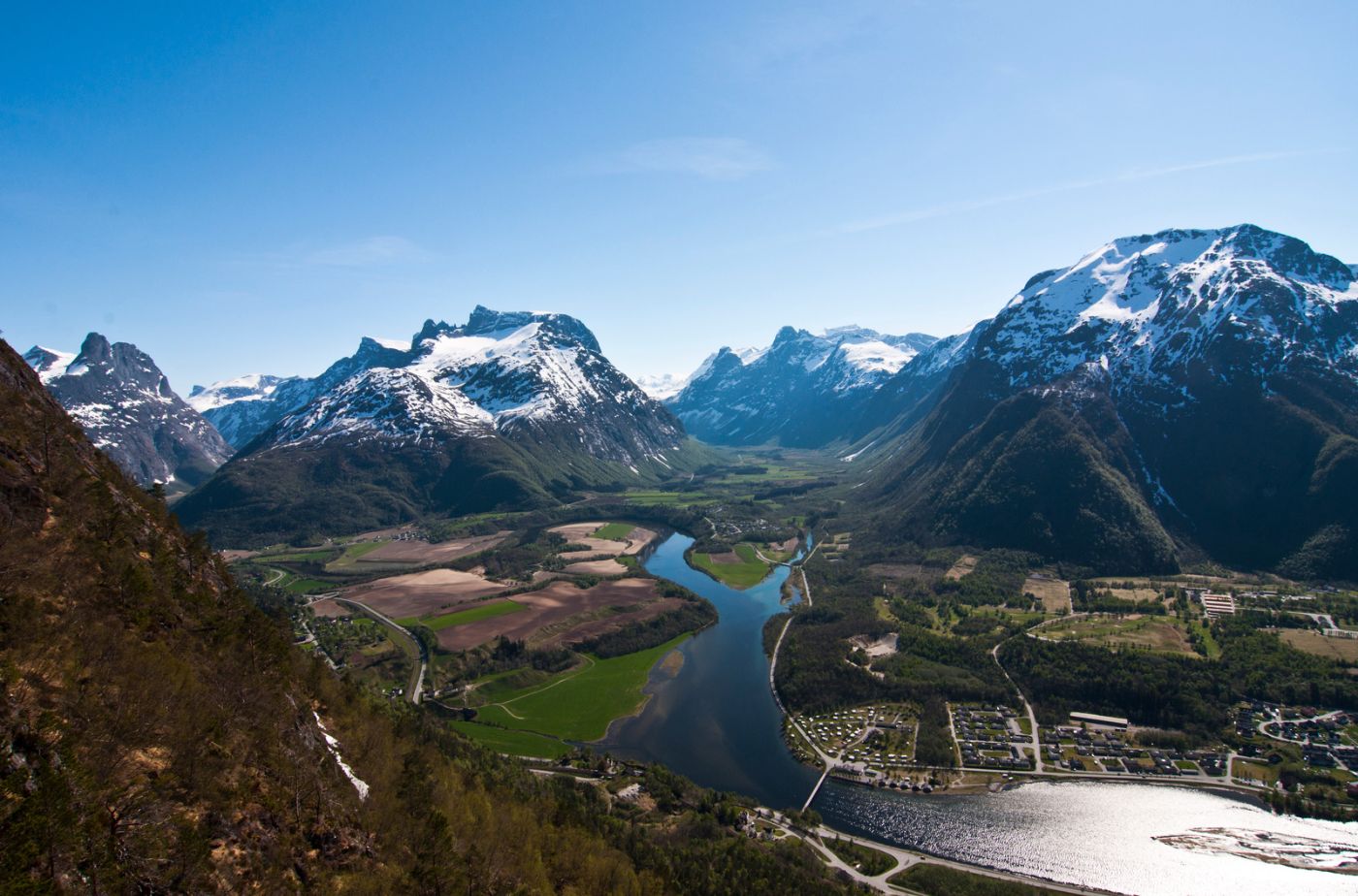
Drive it Yourself: Dombås to Ålesund via Åndalsnes on the E136
Read our road-trip guide for the drive from Dombås to Ålesund on the E136, passing Åndalsnes along the way.
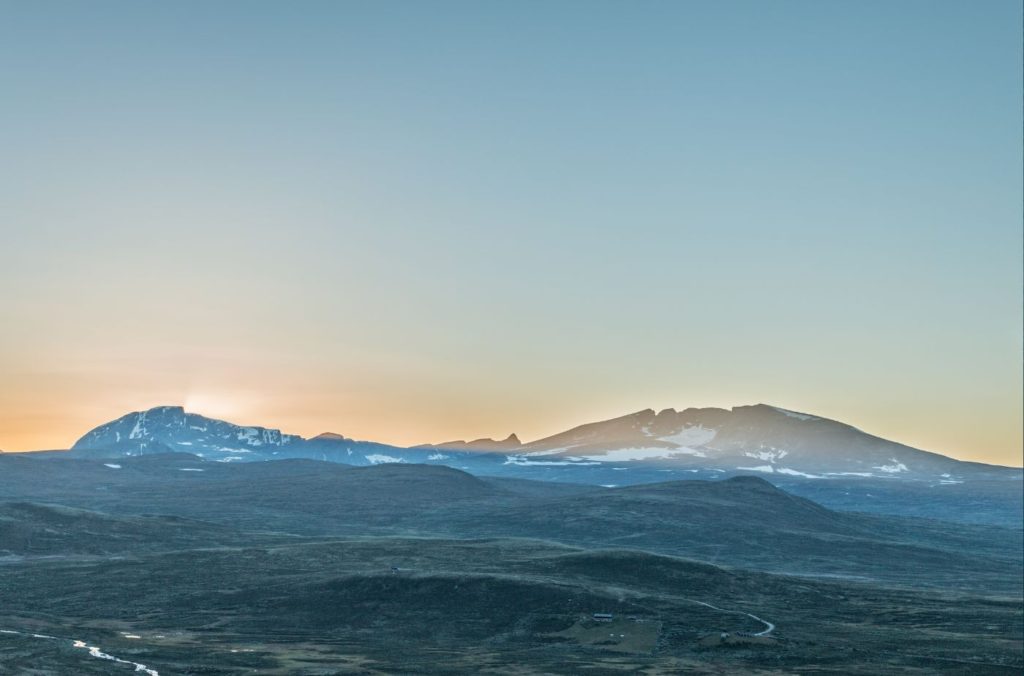
Dombås is like the major intersection of Norway. Road, rail and rivers meet here, plus several national parks. The town itself is not very interesting, but if you want to enjoy the outdoors, Dombås is perfect.
Latitude: 62 degrees north
Population: 1,161
Dovre Municipality
Here are some things that you must do and try in Dombås
Here’s an overview of some of the best things to see and do in Dombås
This vast alpine park lies on Dombås’ doorstep and is a paradise for nature lovers. It’s home to wild reindeer, wolverines, Arctic foxes and the legendary musk oxen – shaggy relics of the Ice Age often seen grazing the tundra.
The park’s 1,693 km² have been protected as wilderness since 2002. In summer, it offers hiking, fishing, and wildlife safaris, and in winter, snowshoeing or skiing. The mighty musk ox has even become a symbol of the Dovre region, and spotting one in the wild is a highlight of any visit.
Looking to go for a hike or take part in a unique experience? Here are our recommendations!
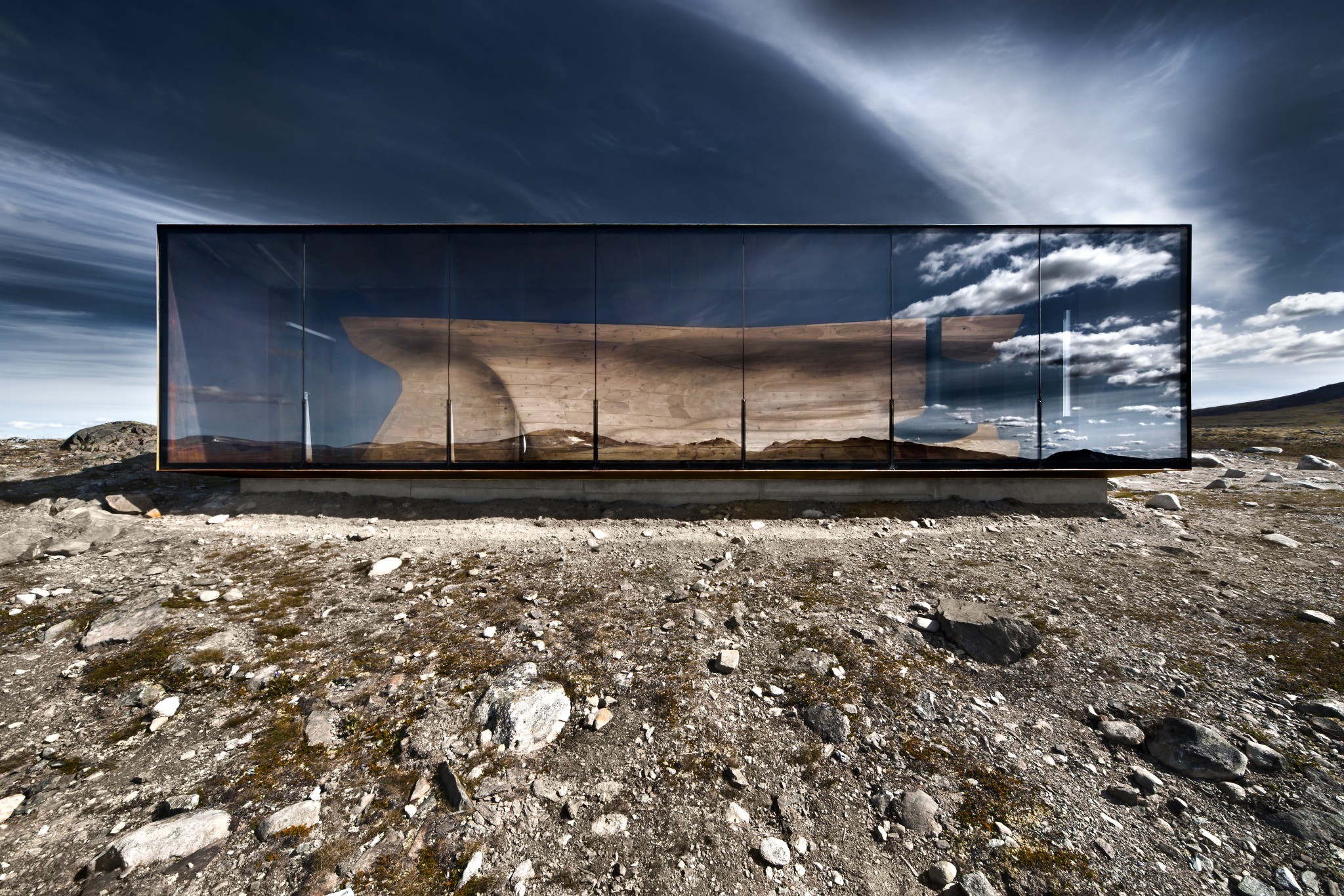
The Norwegian Wild Reindeer Centre is located in the mountains just out of Dombås, and here you can experience the Snøhetta Pavilion. It’s a short walk from the Centre and has incredible views. It won the World Architecture Award in 2011.
Don’t miss the chance to ride the Rauma Railway from Dombås to Åndalsnes – often touted as one of Norway’s most scenic rail journeys. The 90-minute trip winds through wild river gorges and beneath towering peaks, with spectacular mountain vistas along the way. It’s a relaxing excursion for any season (lush green in summer, golden hues in autumn, or snow-draped cliffs in winter). You can do a return day-trip to the fjord-side town of Åndalsnes, or use it as a route onward to the fjords.
The Dovrefjell-Sunndalsfjella National Park is the only place in Europe to see a herd of musk oxen roaming in the wild. Guided tours are organised by Moskus Safari Dovrefjell.
Ambitious hikers can tackle the climb of Snøhetta (2,286 m), the highest peak in Dovrefjell. It’s about a 5–7 hour round-trip trek and, while long, it’s not technically difficult for those used to mountain hiking.
Start from the Snøheim trailhead (a seasonal shuttle from Hjerkinn can take you closer in summer). The reward is immense – on clear days you’ll have panoramic views over the national park’s plateaus and might even glimpse Norway’s other great ranges (Rondane, Jotunheimen) on the horizon. Pack windproof gear; even in summer there can be snow patches near the top.
History buffs will enjoy walking sections of the old King’s Road (Kongevegen) over Dovrefjell, the route that kings and commoners traversed in bygone centuries. One popular stretch is a 7 km hike to Hjerkinnhøe (1210 m) where cairns mark the old royal route and you get sweeping views of Snøhetta and Rondane National Park.
A gentle nature walk can be had at Fokstumyra, where a flat boardwalk loop (~4–5 km) leads you through wetlands and moorland. Allow ~2 hours for the full loop, including time to climb the birdwatching tower for a panoramic look over the marshes. It’s an “eldorado for birdwatchers” and a lovely family hike (just remember to bring insect repellent in summer). Interpretation signs explain the reserve’s ecology – notably that Fokstumyra’s protection in 1923 was one of Norway’s first acts of nature conservation.
Thanks to its highland location, Dombås offers outdoor fun year-round. In winter, hit the local Dombås Ski Centre – a family-friendly ski hill with gentle slopes, ski rentals and floodlit trails for evening runs (the ski lifts sit on the hillside just above town.
Cross-country skiers can enjoy miles of prepared tracks in the area. Come summer, the snow melts to reveal hiking and biking trails; you can even rent bikes in town to cycle routes like the “Tour de Dovre” loop through three national parks.
The long daylight hours are perfect for fishing in mountain lakes or guided horse rides. Nearby adventure hotspots are within reach too – drive 1.5 hours southeast to Sjoa for whitewater rafting thrills, or an hour north to Oppdal for a larger ski resort and downhill bike park
Follow our road-trip guides for scenic trips around Dombås
The E6 is the main highway that runs the entire length of Norway. The section from Oslo to Trondheim is the busiest, passing through the Gudbrandsdalen valley before crossing the mountains towards central Norway. Along the way are many historic sites and points of interest, making it an interesting drive to take.
The E136 is the most impressive of the European highways in Norway. The drive from Dombås from Ålesund starts out just fine, but as you approach Åndalsnes you are met with the most incredible scenery in the country. Trollveggen is a famous stretch of mountains that reach peaks of well over 1000 metres high. The famous Trollstigen Tourist Road also begins on the E136. The old road was, in historic times, an important road for the farmers of the northern part of the Gudbrandsdalen valley and the surrounding mountain villages. They would use the road to get access to the sea, where they could buy items like salt.
This was one of the first roads between Eastern and Western Norway to be paved as a driving road. Old stations still exist along the road where those travelling in carriages would stop to rest.
We currently do not have any self-guided walks available in Dombås
Watch our YouTube videos featuring Dombås
Follow the scenic road from Dombås to Åndalsnes through the Rauma Valley.
Follow us as we make our way from Lom to Dombås, passing by Vågåmo and Sel.
Dombås’ location at the foot of the Dovre mountains made it an important crossroads for travellers even in pre-modern times. By the mid-1800s, it had a coaching inn (Tofte Kongsgård, 10 km south) and soon after a proper skysstasjon at Dombås itself.
Essentially, it is a guesthouse with stables for changing horses, serving those journeying between Oslo (Christiania) and Trondheim. This meant that hospitality is in Dombås’ DNA: the village has been welcoming road-weary guests for centuries. The very name “Dombås” comes from the old Norse Dǫmbáss (likely referring to a local river named Domba, meaning “dark, quiet one”), hinting at the tranquil valley setting that greeted those early travellers.
The 1900s brought major changes as Dombås became a key junction in Norway’s expanding railway network. The Dovre Line railway from the south reached Dombås in 1913 (connecting from Otta), and by 1921 the line continued north to Trondheim. In 1924, the spectacular Rauma Line opened, stretching west from Dombås to Åndalsnes. Suddenly this tiny mountain village was a transfer point for trains, spurring growth and development. Hotels and shops sprang up to serve rail passengers – the original Dombås Hotel was built in 1917 – and the village’s profile as a travel hub was firmly established. You can imagine the era of steam locomotives chugging into Dombås Station, and travellers disembarking to rest here en route between Norway’s capital and its northern cities.
Dombås etched its name in military history during World War II. In April 1940, as German forces invaded Norway, Dombås’ strategic position at the rail and road junction made it a target for a daring assault. On 14 April, German Fallschirmjäger (paratroopers) were dropped into the area to try to seize control.
In what’s now called the Battle of Dombås, Norwegian Army units and local volunteers engaged the paratroopers in a fierce five-day fight, ultimately capturing or killing the German detachment – marking one of the first German combat setbacks of the war. However, retaliation followed: on 21 April 1940, German bombers strafed and bombed Dombås, destroying much of the village centre including the railway station. One of those killed in the bombing was Captain Robert M. Losey, an American military attaché, making him the first US serviceman to die in WWII. Today’s Minneparken in Dombås displays photos and text about these events, ensuring the bravery and losses are not forgotten.
After WWII, Dombås was rebuilt and continued to thrive as a pit-stop on the E6 highway (which was improved in the post-war years) and as a railway junction. The modern E6/E136 road layout, completed mid-century, solidified the village’s role as a transit hub between Eastern, Western, and Northern Norway.
The 1960s saw the development of Dombås Ski Area, adding winter tourism to its economy. In recent times, Dombås has focused on sustainable tourism and leveraging its “National Park Village” status – it’s part of the Nasjonalparkriket (“National Park Kingdom”) and earned a Sustainable Destination certification for its efforts to balance tourism and environment.
Not everything has been smooth: the beloved Dombås Church suffered an arson fire in 2020 which badly damaged its interior, though restoration is underway. And in 2007, the historic Dombås Hotel burned down, only to be rebuilt and reopened in 2014 as a modern hotel. These days, Dombås skilfully blends its rich history with a fresh, forward-looking vibe – the past is visible and honored, even as the town serves the needs of today’s travellers.
Dombås’ economy revolves around serving travellers and the surrounding rural region. Key employers include the hospitality sector (hotels, guesthouses, restaurants), retail and services (the shopping centre, petrol stations, grocery stores), and transportation (railway and road maintenance crews, logistics).
Because Dombås sits at a highway junction, it has amenities beyond what a typical village this size might have – a traveller could fuel up the car, grab a meal, and even get their car fixed or buy outdoor gear here, injecting income into the town. Traditional livelihoods like farming are still featured – you’ll see pastoral farms on the outskirts with sheep and cows. While the growing season is short (the valley sits ~640 m above sea level, with a relatively dry, cool climate), hardy crops like potatoes and barley are cultivated, and summer pastures on Dovrefjell feed livestock that contribute to local dairy and meat production. There’s also a Norwegian Army firing range and garrison not far away at Hjerkinn, where some locals are employed. Unemployment is low, as people often wear multiple hats across tourism and farming throughout the year.
Fly: No airport.
Drive: Driving is a fantastic way to reach and explore Dombås, as it sits at a crucial road junction. The E6 highway (Norway’s main north-south road) passes right through, linking Dombås to Lillehammer (2 hours 15 min south) and Trondheim (3 hours north). From the west, the E136 brings you from Åndalsnes/Molde via a dramatic route through Romsdalen valley.
Dombås is a stop for several long-distance express buses. Nor-Way Bussekspress and others operate routes like the NW431 (Oslo–Trondheim line) which stops in Dombås roughly halfway, and a bus from Lillehammer to Åndalsnes via Dombås.
Train:Dombås is extremely well-connected by rail given its size. Dombås Station lies on the main Dovre Line, with direct trains from Oslo Central (about 4 hours away) and from Trondheim (around 3.5 hours). The train ride up Gudbrandsdalen valley is scenic and comfortable – it’s a popular way to arrive. Uniquely, Dombås is also the transfer point for the Rauma Railway, the branch line heading west to Åndalsnes
Ferry: No ferry access
Dombås itself is very small, so walking is the default way to get around in the village. From the train station, the furthest hotel or restaurant is at most a 10–15 minute walk. In snowy conditions, pavements are cleared regularly, but good boots are advised. There is a taxi stand in the centre (outside Coop prix) – taxis can take you to places like Viewpoint Snøhetta at Hjerkinn or to trailheads like Snøheim (summer only) if you don’t have a car; you can also call and book one in advance. For a bit of fun and exercise, you might rent a bicycle in tow.
To get to any of the hikes or parks, you will need a car.
Dombås Senter (Shopping Mall): The main hub for shopping is the Dombås Senter, a modern yet compact mall conveniently located by the E6.
Cafes & Bakeries
Casual Eateries
Frich’s Kafeteria) – A classic highway café right on the E6, popular for a rest stop any time of year. This cosy cafeteria serves traditional Norwegian fare like meatballs, hearty stews, sandwiches, and homemade cakes for those after a light bite. The interior is warm and unpretentious – long tables, a fireplace, and friendly staff who’ll happily refill your coffee. Don’t forget to snap a photo with the giant troll statue that “guards” the hall – a fun nod to the Hall of the Mountain King. It’s open early till late, catering to road-trippers needing a meal or just a waffle and coffee.
Moskusgrillen – As the name hints (moskus = musk ox), this grill in the heart of Dombås is known for its wild-game twist on fast food. It’s essentially a classic Norwegian diner: order at the counter from a menu of burgers, hot dogs, and kebabs, then grab a booth. Their specialty is the “Elgburger” – a homemade elk burger – and other traditional dishes like meatcakes and salt-cured lamb, alongside the usual fries and pizza offerings.
High End & Unique Eats
Dombås Hotel Restaurant – The most upscale dining option in town is at the Dombås Hotel. Its in-house restaurant (open to non-guests as well) offers a mix of Norwegian and international cuisine in a refined, recently renovated setting. Think white tablecloths, a wine list, and attentive service – yet still with a relaxed mountain town feel. Even breakfast here is a feast (a lavish buffet of local cheeses, smoked salmon, eggs and more). In the evenings, the kitchen often features regional specialties like roast reindeer, trout from nearby rivers, and house-made desserts using cloudberries.
Trolltun Gjestegård Restaurant – Set at the base of the ski slopes 1.5 km above the centre, Trolltun’s restaurant is a hidden gem known for its rustic charm and mountain views. The menu showcases local game and farm-to-table produce, which is their specialty.
Kongsvold Fjeldstue – For a truly special dining experience, consider a jaunt to Kongsvold Fjeldstue, about a 30-minute drive north of Dombås (just over the county border). This historic mountain lodge dates back to the 12th century and has been one of Norway’s most charming inns for travelers. Its restaurant is high-end, serving gourmet 3-course dinners by candlelight in a centuries-old timber hall.
All my hotel recommendations are based on research and experience. I don’t recommend somewhere unless I think it is wonderful! The Hidden North focuses on accommodation that provides good quality for price or offer local or unique experiences.
Camping
Bjorkhol Camping has excellent facilities and it is possible to catch a bus here from Dombås.
Dombås Hostel offers shared rooms and private rooms.
Click here to view rates & book
Ljoshaugen Camping – A convenient camping ground just 300 m from Dombås centre, Ljoshaugen is a top choice for budget travellers and outdoorsy families. They offer tent pitches, RV parking, and several simple cabins for rent. The cabins come with bunk beds and basic kitchen facilities, perfect if you want self-catering.
Lodges & B&Bs
Dombås Vandrerhjem is a hostel with 13 rooms. All rooms have their own bathroom.
Trolltun Hotel & Hytter is a reasonably priced hotel with cabins for rent. rolltun is both a hotel and cabin resort, sitting up by the ski lifts. It offers an excellent mid-range stay with a dose of alpine charm. You can choose between hotel rooms (simple and clean, many with valley-view balconies) or renting a self-catering chalet cabin. The property has a sauna, a licensed bar, and even a night club in winter (well, more of a pub that livens up during ski season)
Click here to view rates & book
Dovrefjell Lodge – For a step up in comfort while still in nature, consider the cabins at Dovrefjell Lodge, about 15 km north of Dombås on the road toward Hjerkinn. Here you’ll find modern, cosy cabins in a mountain lodge setting. Each cabin is well-furnished in rustic style, with warm colours and that classic Norwegian hytte feel. Most have a living room (sofa, coffee table, maybe a fireplace), a fully equipped kitchen, a bedroom with comfy beds, and a private bathroom. They also have regular hotel rooms, if that’s your preference.
Chains & Mid-Range
This is the main hotel in town, a solid mid-range option that was completely rebuilt in 2014, offering modern facilities. It’s centrally located yet quietly set back from the main road, with 99 rooms (so you can often find availability).
High End & Unique Properties
Kongsvold Fjeldstue – As mentioned in Restaurants, Kongsvold is also an accommodation and truly one of the region’s most special places to stay. It operates as a historic mountain lodge/inn with beautifully preserved timber buildings and rooms full of character (antique furniture, lace curtains, and creaky wooden floors that have welcomed guests for 300 years). This is high-end in a traditional sense – don’t expect a spa or TV in every room, but rather an immersion into Norwegian heritage with modern comforts. Each room is different; some have canopied beds, others loft layouts.
Read our road-trip guide for the drive from Dombås to Ålesund on the E136, passing Åndalsnes along the way.
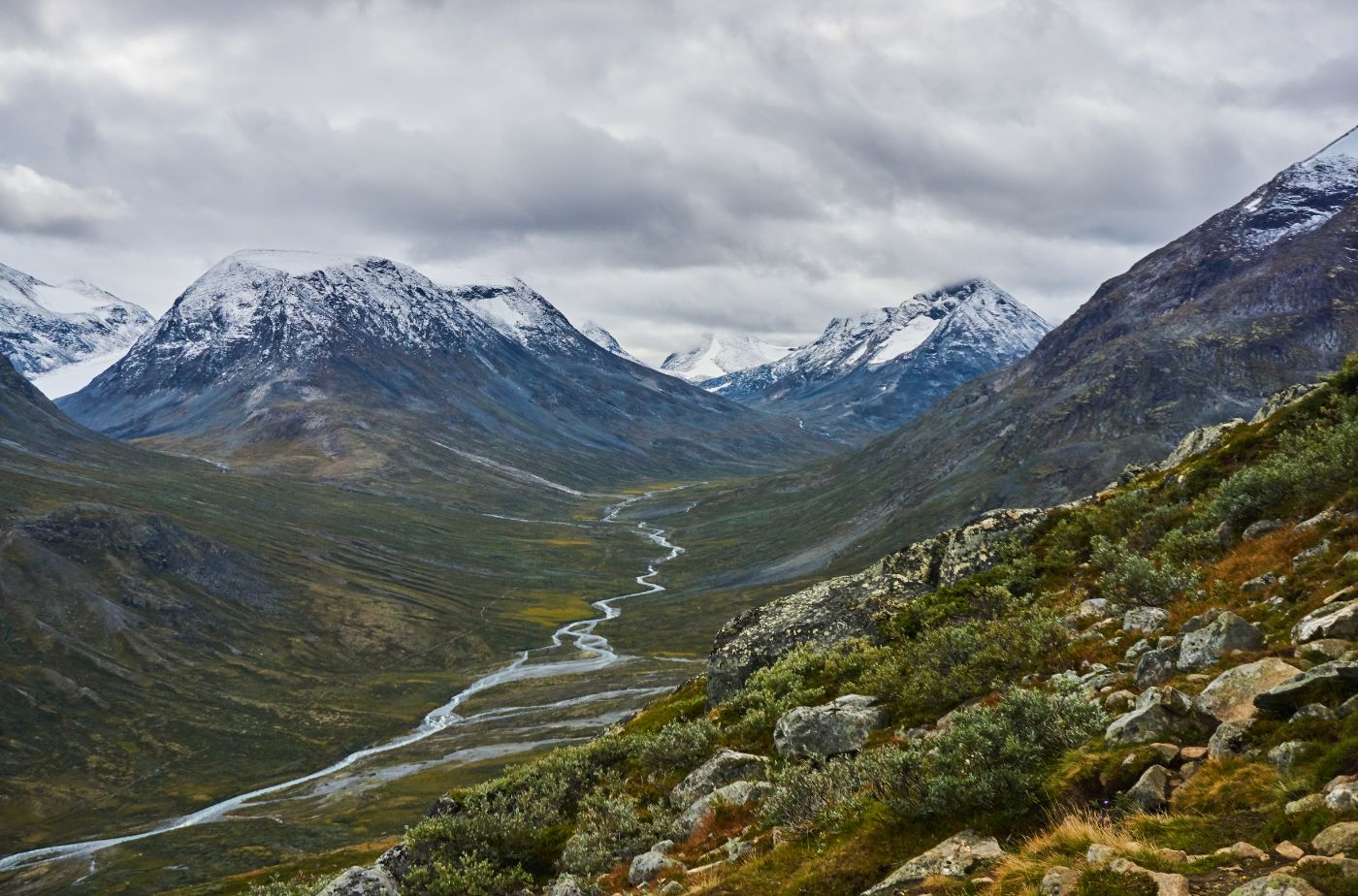
Read our road-trip guide for the drive from Lom to Dombås via the Rv15 and E6.
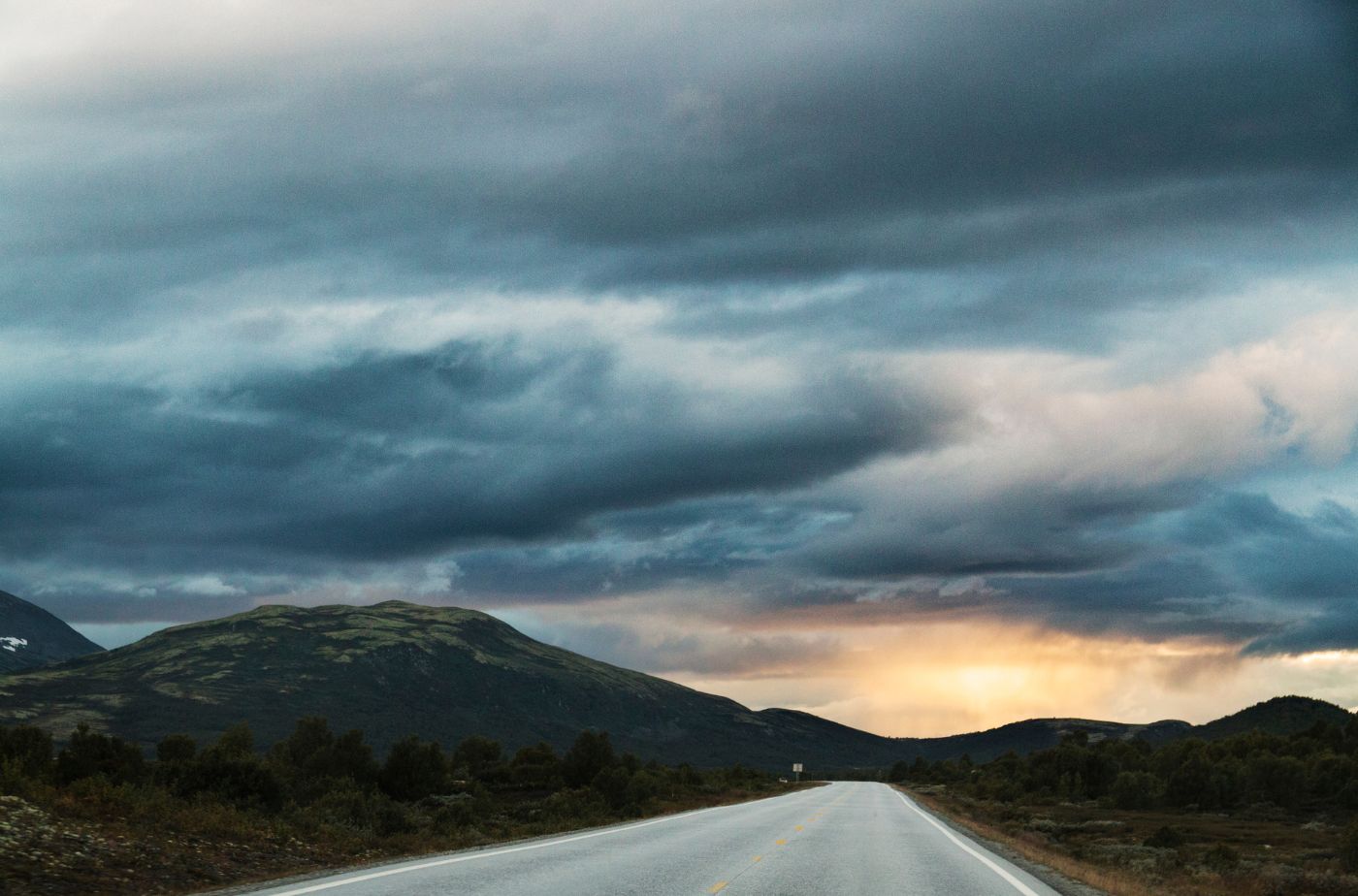
Take the major highway E6 between Oslo and Trondheim.