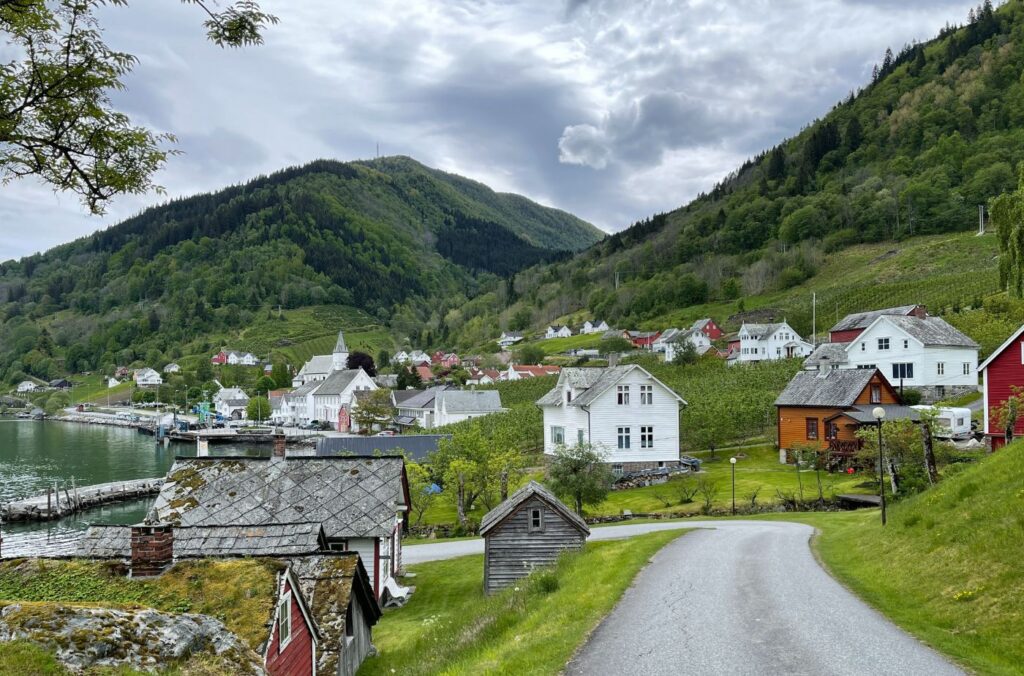
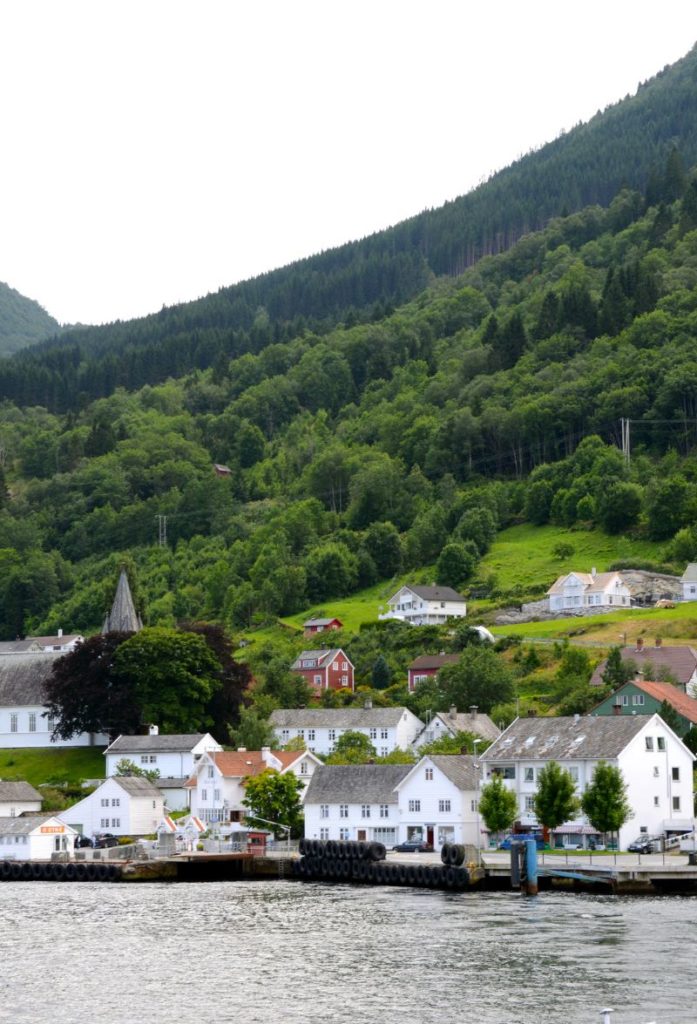
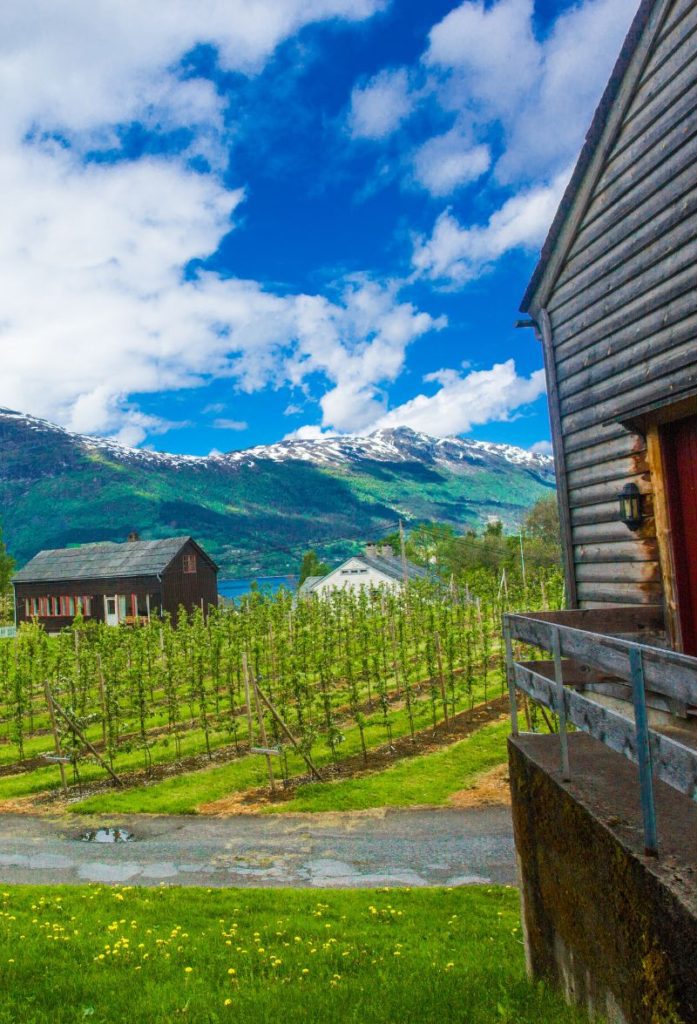
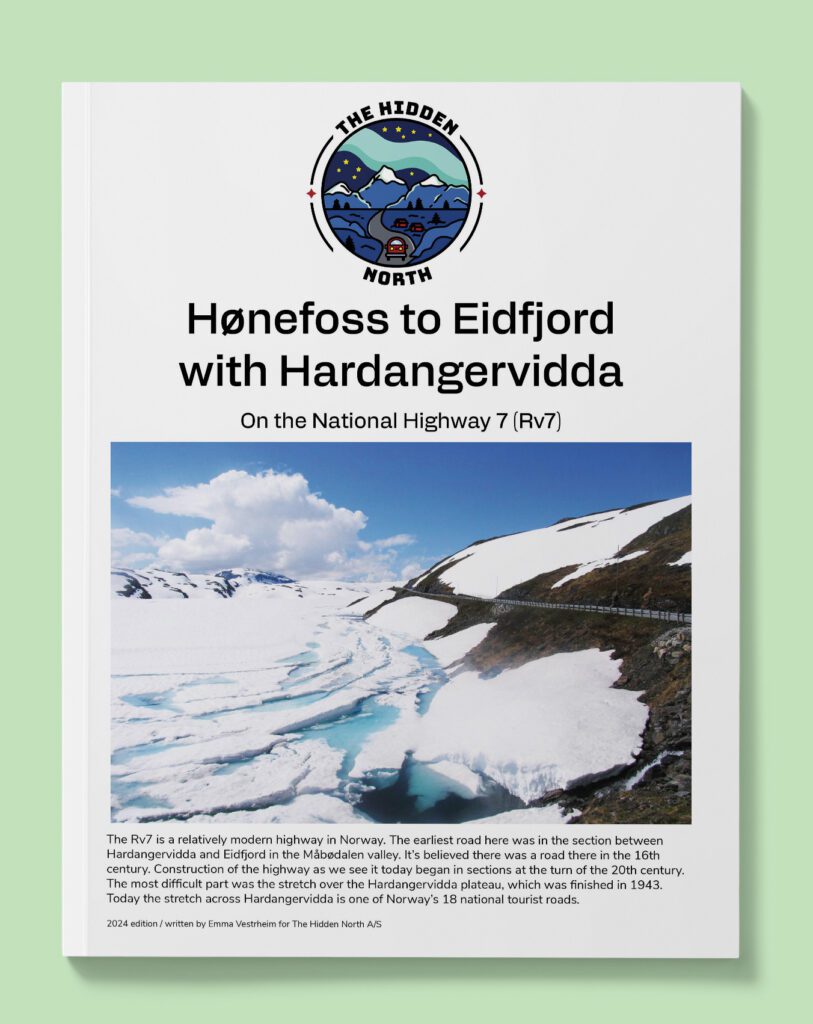
The Ultimate 7-Day Fjord Road-trip in Norway
I’ve written many guides to the various highways and tourist roads around Norway, but I thought it was about time I shared some of my favourite road-trip itineraries! So, here’s my ultimate fjord road-trip.
For this first itinerary, I’ve compiled a seven-day road-trip guide from Bergen, focusing on the scenic roads and various fjord regions. If you want to see as much of Western Norway as possible within seven days, this is your road trip. If possible, try to break it up with two-night stays in places such as Geiranger, Åndalsnes, or Bergen.
Starting Point
This drive starts in Bergen. I chose Bergen because it is the ‘capital of the fjord region’ and the most easily accessible by plane or train. While Oslo may seem like an obvious choice to start a road trip from, the eastern part of Norway just isn’t as scenic as the west coast.
How You Get Around
You need to rent a car for this trip. Motorhomes, caravans, and RVs work, too. Public transport is not possible.
3. This is a ‘fast trip’
This is what I call a ‘fast trip’—it packs as much into your one week in Norway as possible. If you want a slower trip, consider breaking up the drive with two—to three-night stays in places.
Day-by-day Itinerary
Day 1: Bergen to Ulvik
Fjords: Hardanger
Tourist Roads: Hardanger Tourist Road
Fjord Road-trip Drive Time: 2 hours 45 minutes (without stops)
Ideally, you should spend two nights in Bergen. Give yourself enough time to explore the city, take the Fløibanen, join us on a walking tour, and try some of the local restaurants.
If you’re renting a car for this trip, the easiest place to get a rental car is in the city centre, close to one of the Bybanen stops. If you are spending two nights in Bergen, you won’t need a car while exploring the city.
I recommend using Avis in Bergen city centre.
Now, it’s time to hit the road! To get out of Bergen, follow the E16 highway. It’s surprisingly hard to find food along the Hardanger Tourist Road – you can find grocery stores in Norheimsund and Øystese. I recommend stopping at the Åsane Storsenter grocery store on your way out of Bergen and visiting a bakery to get some fresh buns or sandwiches.
From there, you turn off towards Hardanger and the Hardanger Tourist Road.
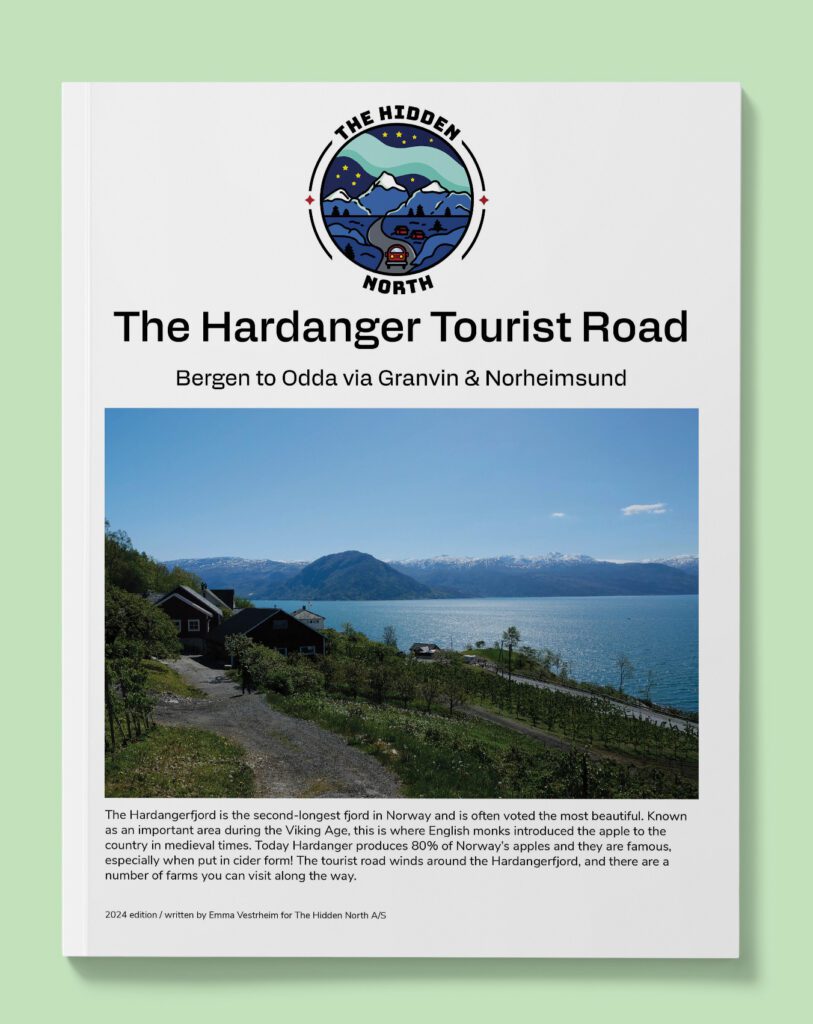
Hardanger Tourist Road
You can find my guide to the Hardanger Tourist Road by clicking the link below.
Stop 1: Fossen Bratte
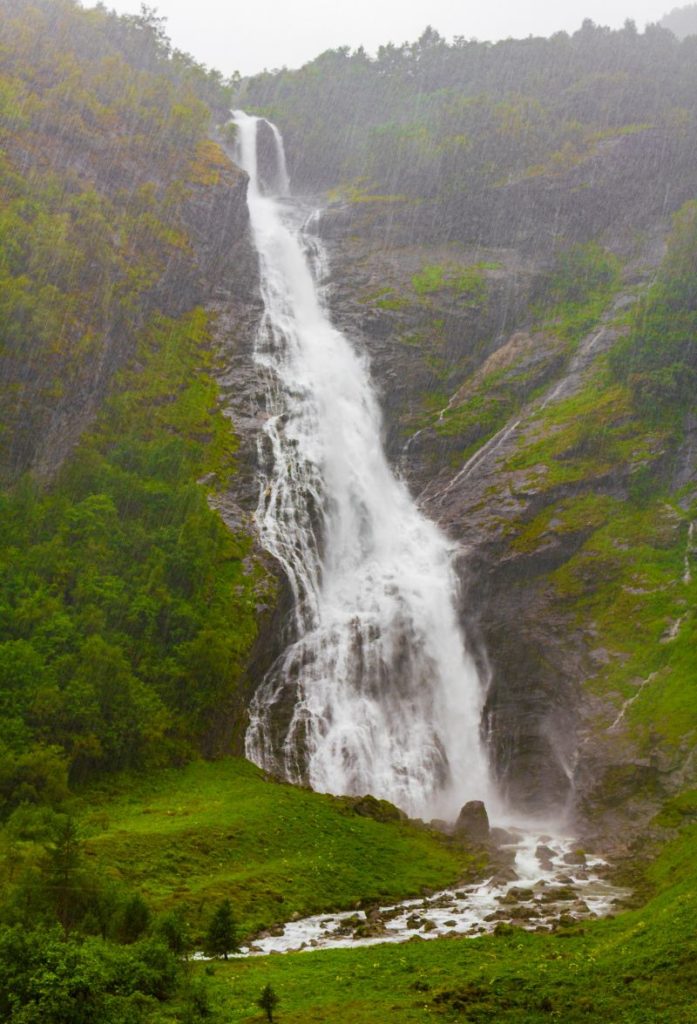
Fossen Bratte means ‘steep waterfall,’ and the river Eikedalselva thunders down in a single drop over 79 metres. From the parking lot, you can walk to the toilets, where a path leads you to the base of Fossen Bratte. In 1951, a newlywed couple was on their honeymoon when they crashed at the Fossen Bratte. At the bottom of the Fossen Bratte, there is a memorial plaque set up.
There is also a war memorial marker here. In April 1940, the German advance towards Voss followed three offensives: Along Bergensbanen, through the valley near Granvin, and along Hardangervegen. Here the waterfall Bratte formed an almost impenetrable barrier. In the afternoon of 22 April 1940, German forces advanced against the Norwegian security forces and volunteer riflemen stationed at the waterfall. There is a memorial for the three fallen Norwegians.
Here you can see bits of the old highway. It was replaced by the tunnel in 1976.
You then drive through a ski centre before descending to Stop 2.
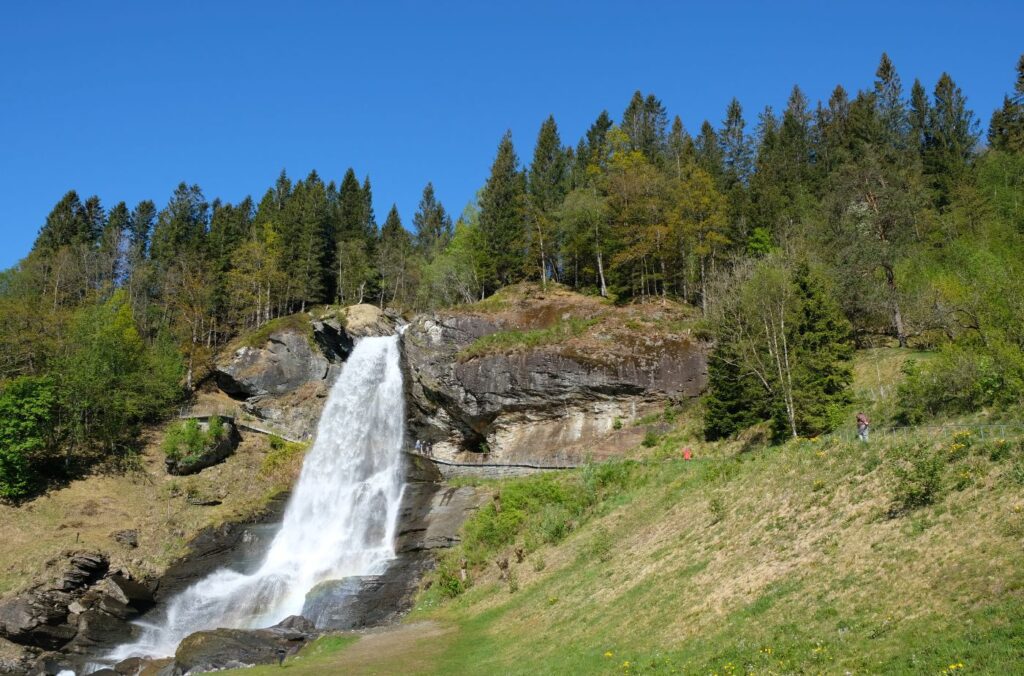
Stop 2: Steindalsfossen
Steindalsfossen is a famous waterfall in Norway. It has a 20-metre drop and good water flow, especially in May and June when the snow melts. There is a path behind the waterfall.
It’s easy to park here, though there may be tour buses. Public restrooms are also available.
Once in Norheimsund, you can stop for restrooms or continue to Øystese. You are now driving on the Hardanger Tourist Road, your first tourist road!
Take the Hardanger Tourist Road from Norheimsund to Kvanndal.
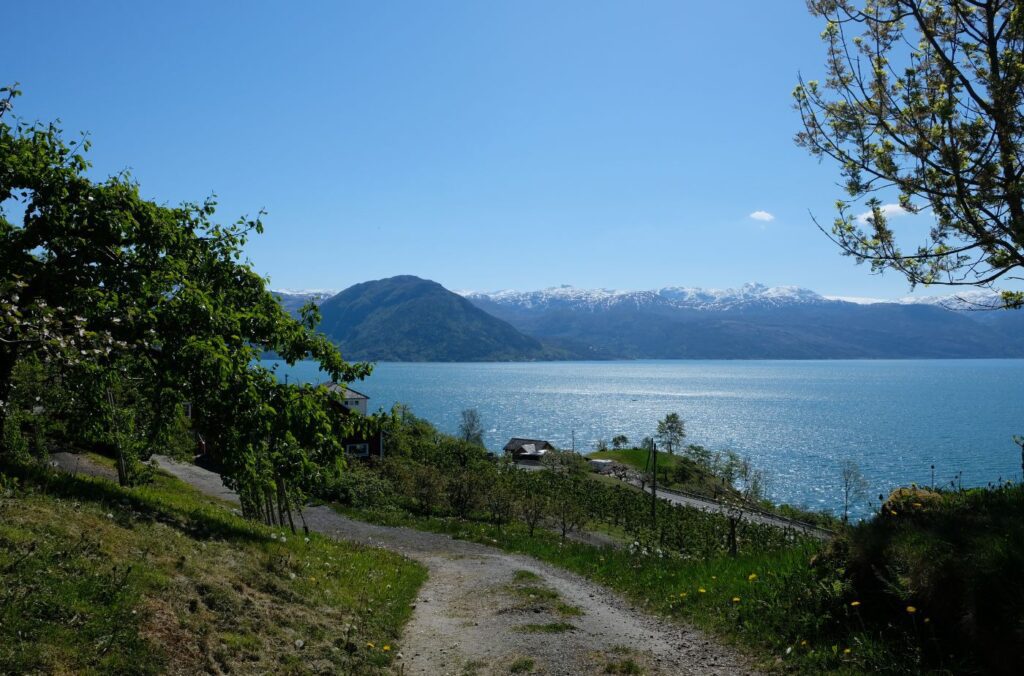
Stop 3: Steinstø Fruit Farm
Steinstø Fruktgard is a well-known family-run fruit farm and shop located along the side of the road shortly after Øystese. The farm has been operated by the Steinstø family for multiple generations and is situated along the famous Hardangerfjord, a region celebrated for its fruit orchards and stunning natural beauty.
The shop offers a wide range of fresh, local produce, including apples, cherries, plums, pears, and berries, depending on the season. They are also known for homemade products such as jams, juices, ciders, and baked goods like apple cake.
The farm shop typically has a small café where visitors can enjoy coffee, cakes, and light meals while overlooking the fjord.
Note – the farm is closed in 2025 due to personal reasons.
Detour: Utne
Depending on time, I recommend the detour to Utne. Utne is one of the most beautiful towns in Hardanger and is home to the Hardanger Folke Museum, a worthwhile museum about farming history in the region. The museum does have a café, but it’s not always open. Around Utne, you can find farms selling apples and other fresh produce.
The ferry to Utne departs regularly. If you leave your car parked at Kvanndal and go on the ferry on foot, you can use the ferry for free. There’s no car needed at Utne, unless you want to drive to some of the farms.
Final Stop: Ulvik
Ulvik is a charming fjord town located near the end of the Hardangerfjord. The town is known as one of the best places for apples in all of Norway, and there are several farms here producing apples that you can visit throughout the day. In the town centre, you find the lovely historic Brakanes Hotel.
Where to Stay: Ulvik
The Brakanes Hotel in Ulvik is a popular fjord-side hotel. 80 of the 143 rooms have a view out to the fjord, and there’s a large carpark with free parking. The restaurant focuses on local ingredients and fresh produce, including fish from the fjords, fruit, and game.
Alternatively, you can stay at Utne Hotel in Utne. It’s one of the oldest hotels in Norway and has a fine-dining restaurant that focuses on local ingredients. The hotel is rather high-end (as is reflected in price) and you’d need to book well in advance to get a place there.
Be Sure to Try: Hardanger Cider
Hardanger is famed for its apples and cider. Hardangersider has a protected status (akin to Champagne) and a crisp flavour – you can find cider for sale in shops, grocery stores, farms, museums, or restaurants.
Day 2: Ulvik to Aurland
Fjords: Aurlandsfjord
Tourist Roads: Hardangervidda Tourist Road
Fjord Road-trip Drive Time: 3 hours 50 minutes (without stops)
Today is all about the mountains that divide eastern and western Norway. You don’t spend too much time down by the fjords, but rather high above the treeline in what feels like a completely different world. The main road you’ll be driving on today is the Hardangervidda Tourist Road, which crosses the Hardangervidda plateau and national park. It is one of the only places in Western Norway where you can observe wild reindeer, and one of the Star Wars movies was filmed here.
After lunch in Geilo, arguably Norway’s most popular ski town, it’s time to cross the mountains down to Aurland, a charming fjord-side town near the more-famous Flåm. The road you’ll take to Aurland is remote, rugged, and incredibly scenic.
Hardangervidda Tourist Road
You can find my guide to the Hardanger Tourist Road by clicking the link below.
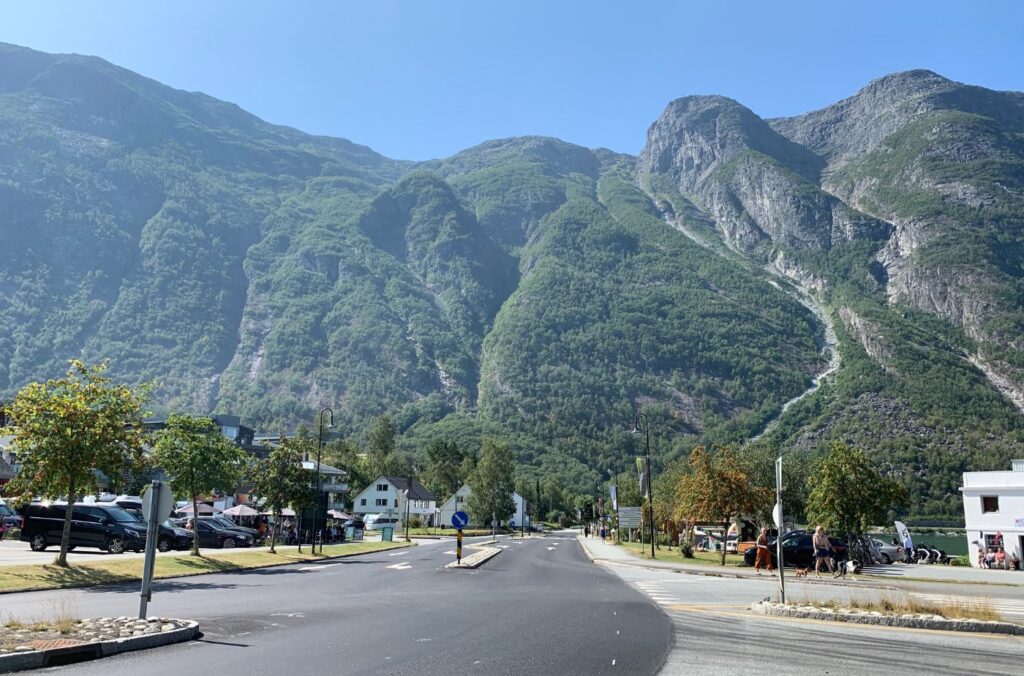
Stop 1: Eidfjord
After leaving Ulvik, you’ll make your way towards the Hardanger Bridge, an impressive new bridge that crosses the scenic Hardangerfjord. Once on the other side, it’s a short drive to Eidfjord.
Eidfjord is a popular tourist town and cruise port, so you’ll find several cafes and shops here. It’s worth parking in town and going for a stroll. I quite like “Fjell & fjord kafe og Kremmeri” for my morning coffee!
If you want to go for a nice walk, I recommend walking to Eidfjord Gamle Kyrkje and back.
If you like museums, continue driving to Øvre Eidfjord to the Norwegian Nature Centre. This museum is about the natural history of the fjord region and has exhibitions on everyday life here. Their shop/café – Hardangerviddahallen – has some nice local produce and Hardanger cider for sale!
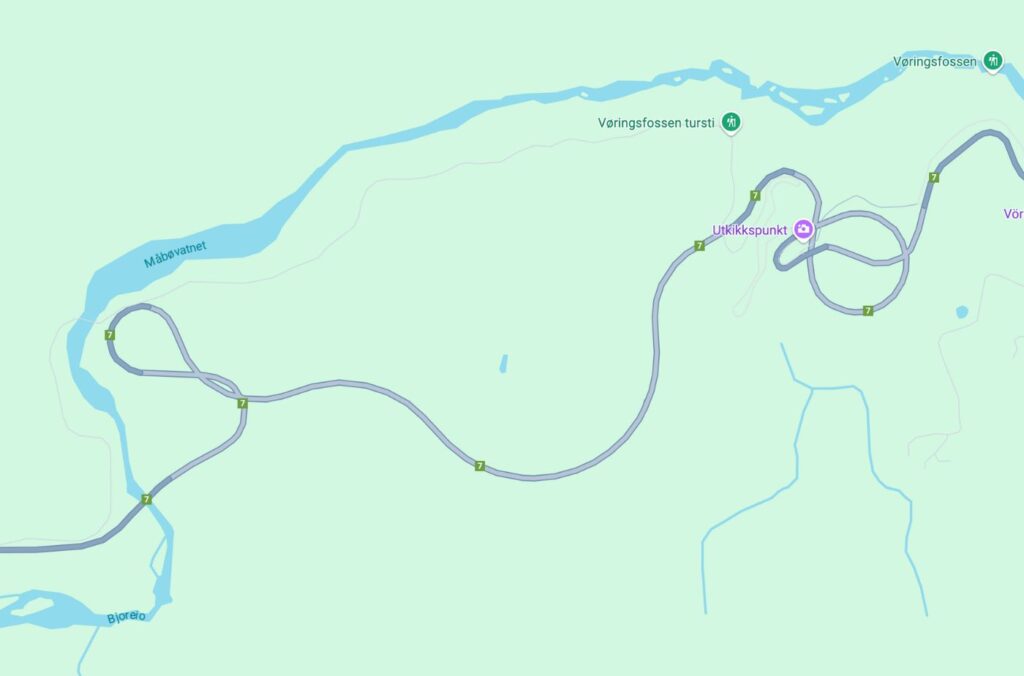
Now it’s time for a scenic drive! Follow the Rv7 through the various roundabout tunnels as you navigate up the mountain to Vøringsfossen. It’s quite a journey up!
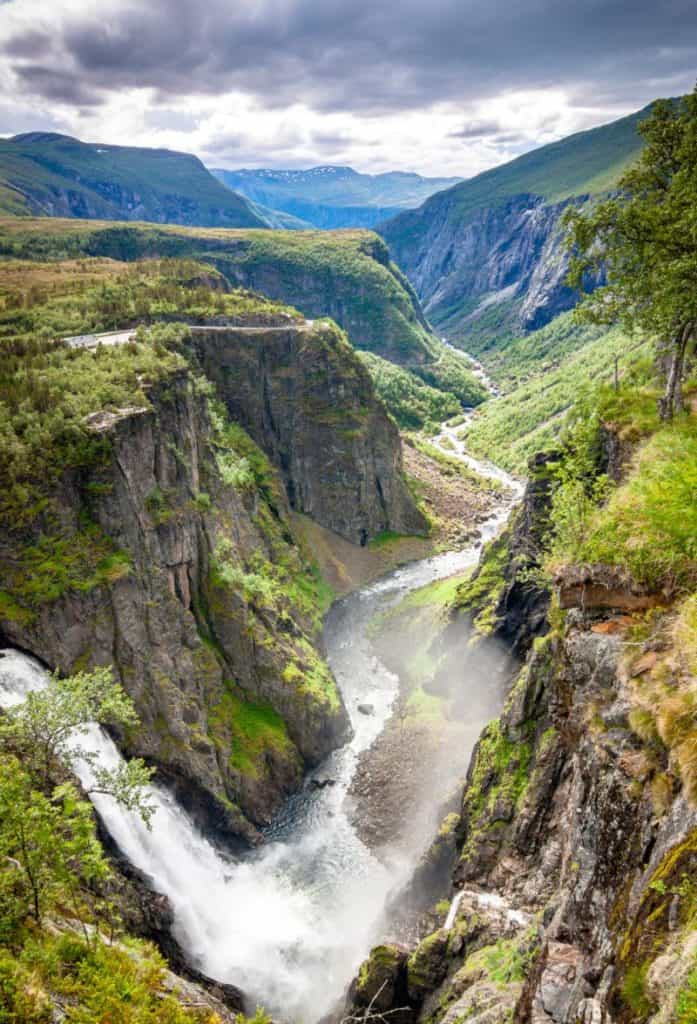
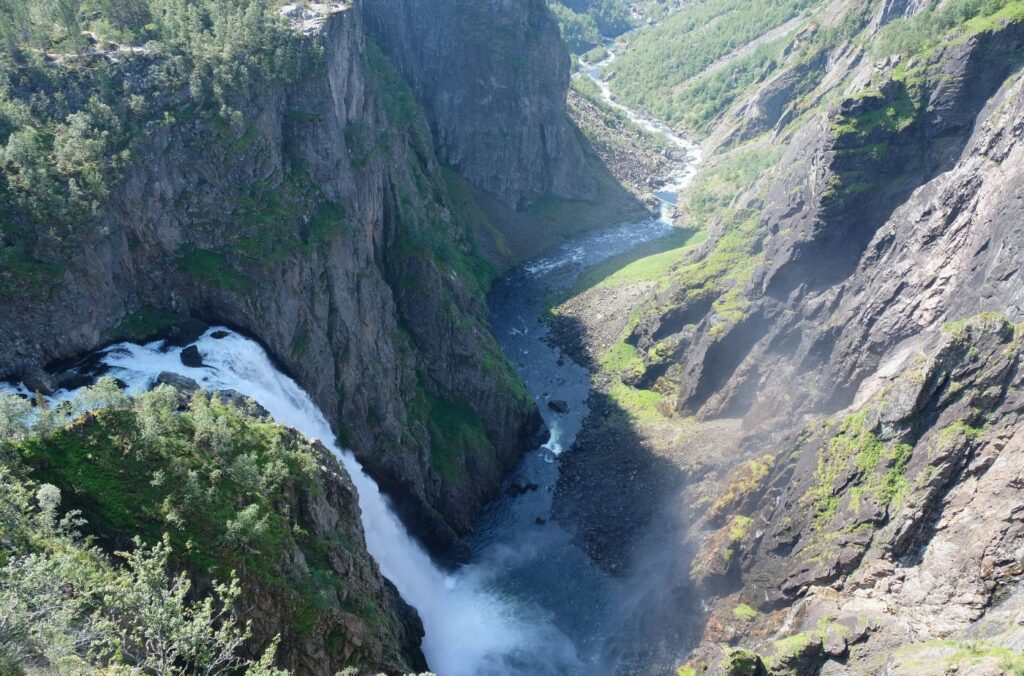
Stop 2: Vøringsfossen
This is one of the most photographed waterfalls in Norway! There’s a viewing platform above the waterfall with free parking, but if you leave it until after lunch, expect a ton of tour buses.
Read more: Stopping by Norway’s most famous waterfall, Vøringsfossen
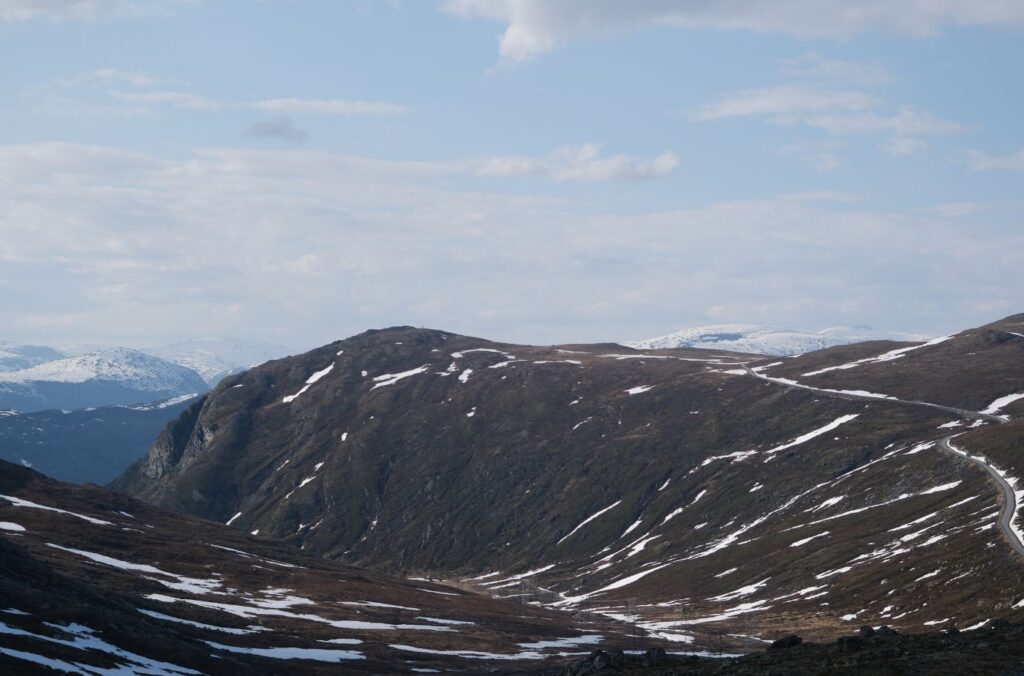
After Vøringsfossen, you drive on the Hardangervidda Tourist Road. The road climbs from sea level to over 1,200 metres onto the plateau, offering dramatic mountain vistas. The route even goes above the tree line, making it a very unique drive in Western Norway.
Stop 3: Geilo
Stop for lunch in Geilo, one of the most popular ski resort towns in Norway. You can find free parking at the shopping mall AMFI, and from here you can for for a walk around the town looking for a bite to eat. There’s a ton of sports clothing stores here, in case you are in the market for a new raincoat!
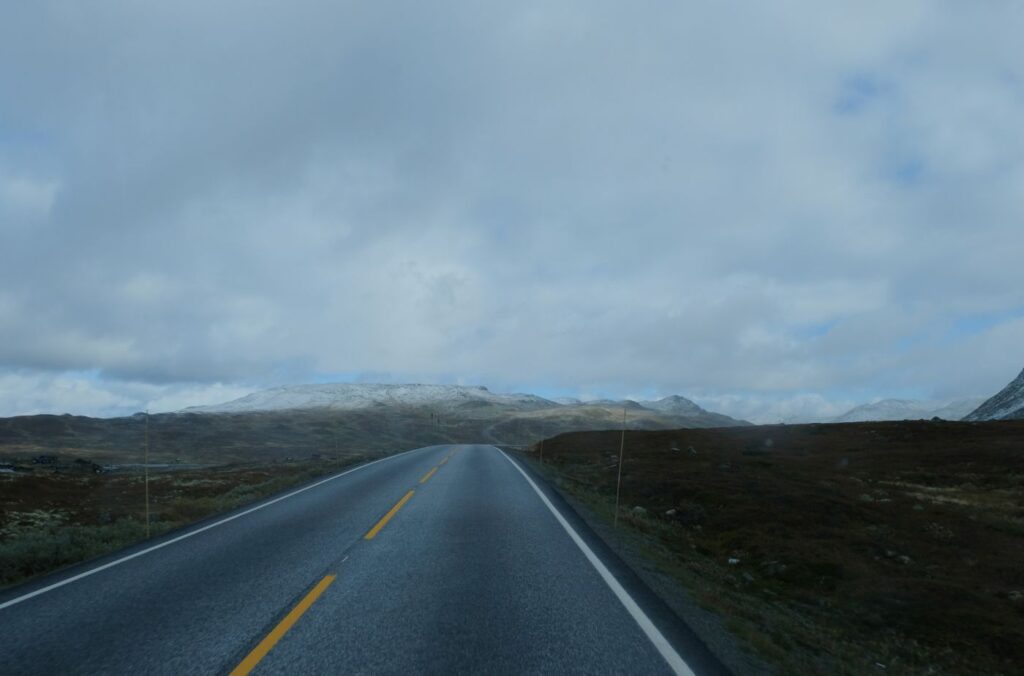
When you get to the village Hagafoss, you’ll turn onto the Fv50 and take this very remote road to Aurland. This is exactly why I love this road; compared to many of the scenic roads you’ll be driving on, this one is fairly unknown by tourists. You don’t pass through any villages or any scenic photostops; it’s more the sense of adventure that makes it so wonderful to drive on.
The Fv50 from Hagafoss to Aurland
You can find my guide to the Fv50 by clicking the link below.
Final Stop: Aurland
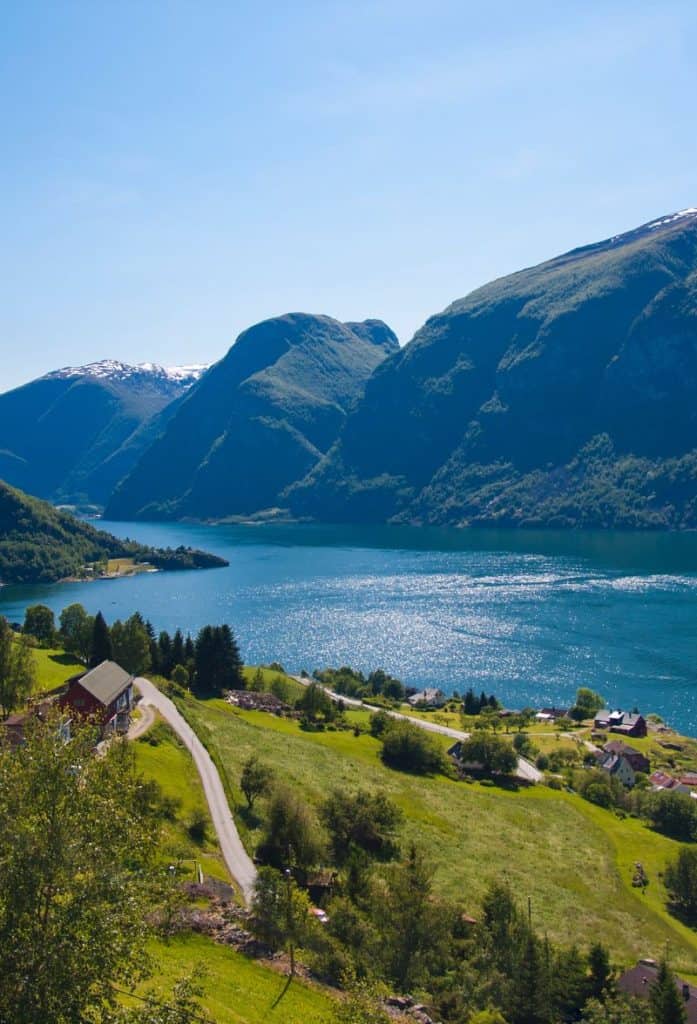
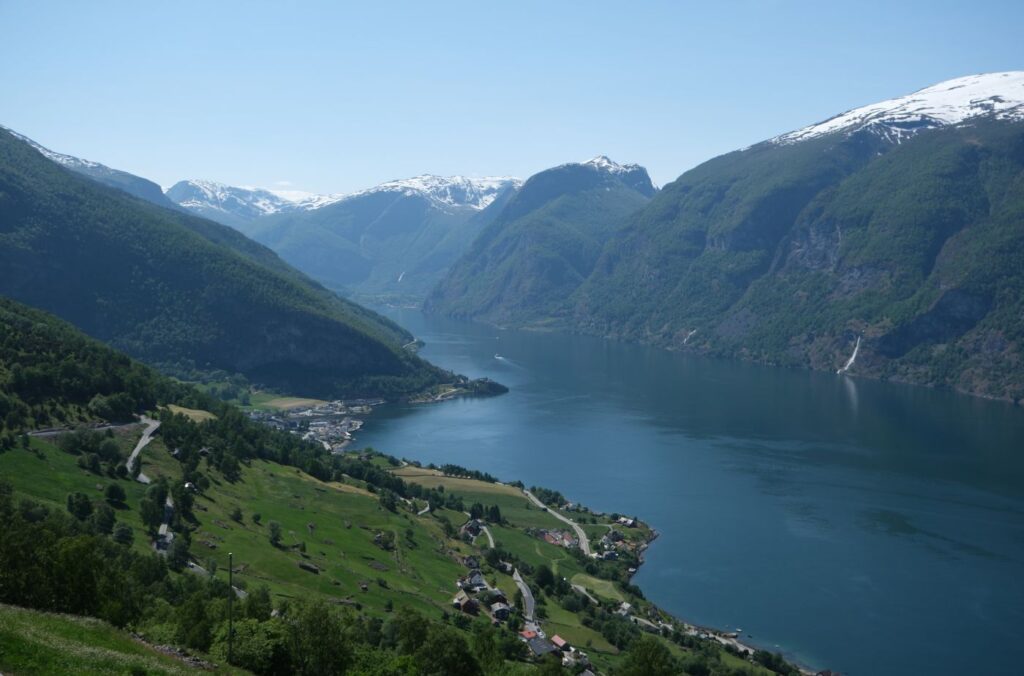
Located just ten minutes from the far more famous Flåm, Aurland is a small village located on the Aurlandsfjord, arguably one of the most beautiful fjords in the country. In Aurland you’ll find the medieval Vangen Church, built in stone. Close by is the 17th-century Otternes farm, and behind Aurland you find mountains popular for hiking.
If you get to Aurland in good time, you can venture into Flåm and book the Flåm Railway, go souvenir shopping, or try Ægir beer at the microbrewery. Free parking is available in Flåm. However, if you are doing this trip during the high season, I would recommend avoiding Flåm until the evening.
Where to Stay: Aurland
Aurland has several quality hotels. I particularly like Hotel Aurlandsfjord and Vangsgaarden Gjestgiveri, both located in the village centre. If you want to stay in a cabin a little out of town, I recommend Aurland Fjordhytter.
Be Sure to Try: Goat Cheese
Aurland is famous for its goat cheese, particularly brown cheese. You can get this at any supermarket or in your hotel.
Day 3: Aurland to Geiranger
Fjords: Sognefjord, Geirangerfjord
Tourist Roads: Aurlandsfjellet Tourist Road & Sognefjellet Tourist Road
Fjord Road-trip Drive Time: 4 hours 50 minutes (without stops)
Ready for scenery overloard? Today is the day for two of the most spectacular drives you’ll do on the whole journey. These two tourist roads are connected by a very unknown road called Tindevegen. When I discovered this road in 2023, I was amazed by how scenic it is! I would say it’s the most secret but most stunning road in the country.
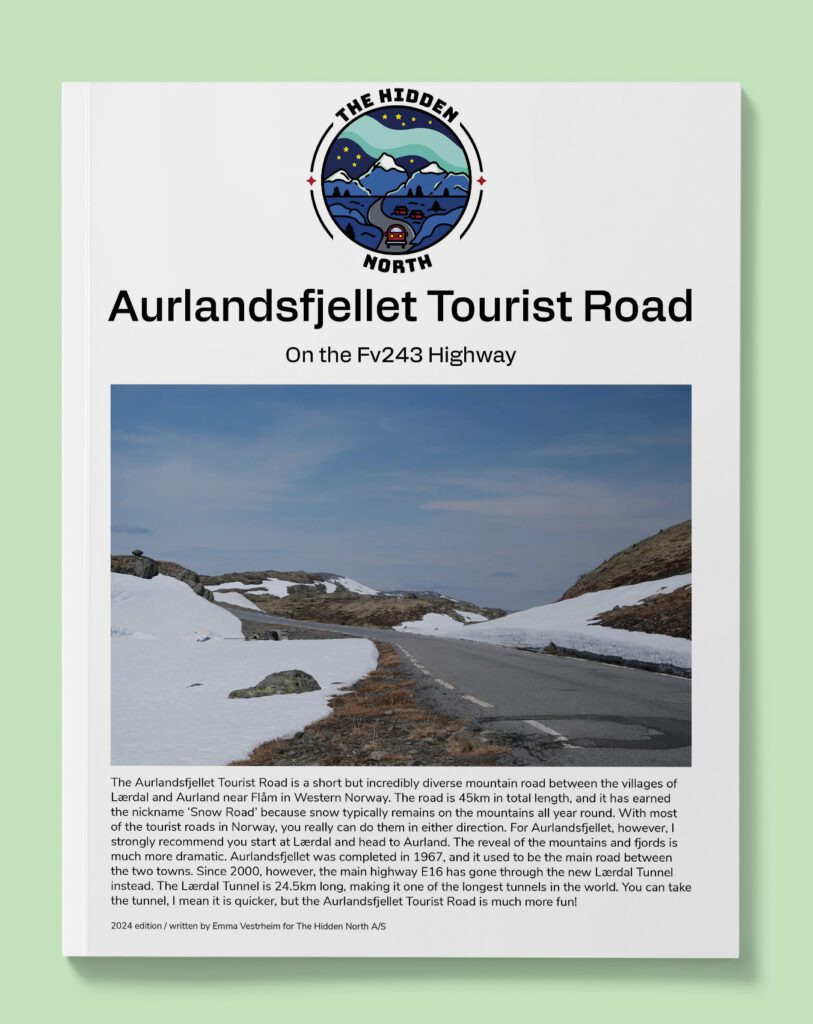
Start your day by taking the Aurlandsfjellet Tourist Road from Aurland to Lærdal. This is a short but dramatic road, crossing the mountains between Aurland and Lærdal.
If you are short on time, or just want to get to Geiranger early, then I recommend skipping this tourist road and taking the Lærdal Tunnel – the world’s longest road tunnel. Not as scenic (obviously), but it takes only 20 minutes to drive through, compared to the 1 hour you’ll need for the scenic road.
Aurlandsfjellet Tourist Road
You can find my guide to the Fv50 by clicking the link below.
Stop 1: Stegastein Viewpoint
No trip on Aurlandsfjellet is complete unless you stop for photos at Stegastein Viewpoint! It can get pretty crowded here, so it’s best to get here nice and early.
Stop 2: Lærdal
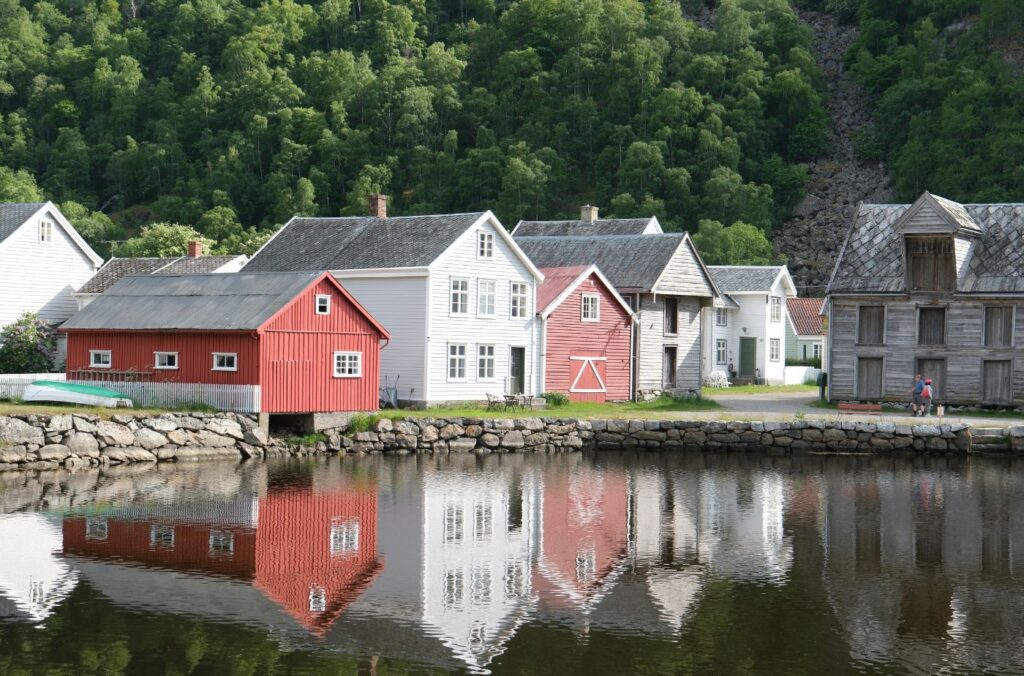
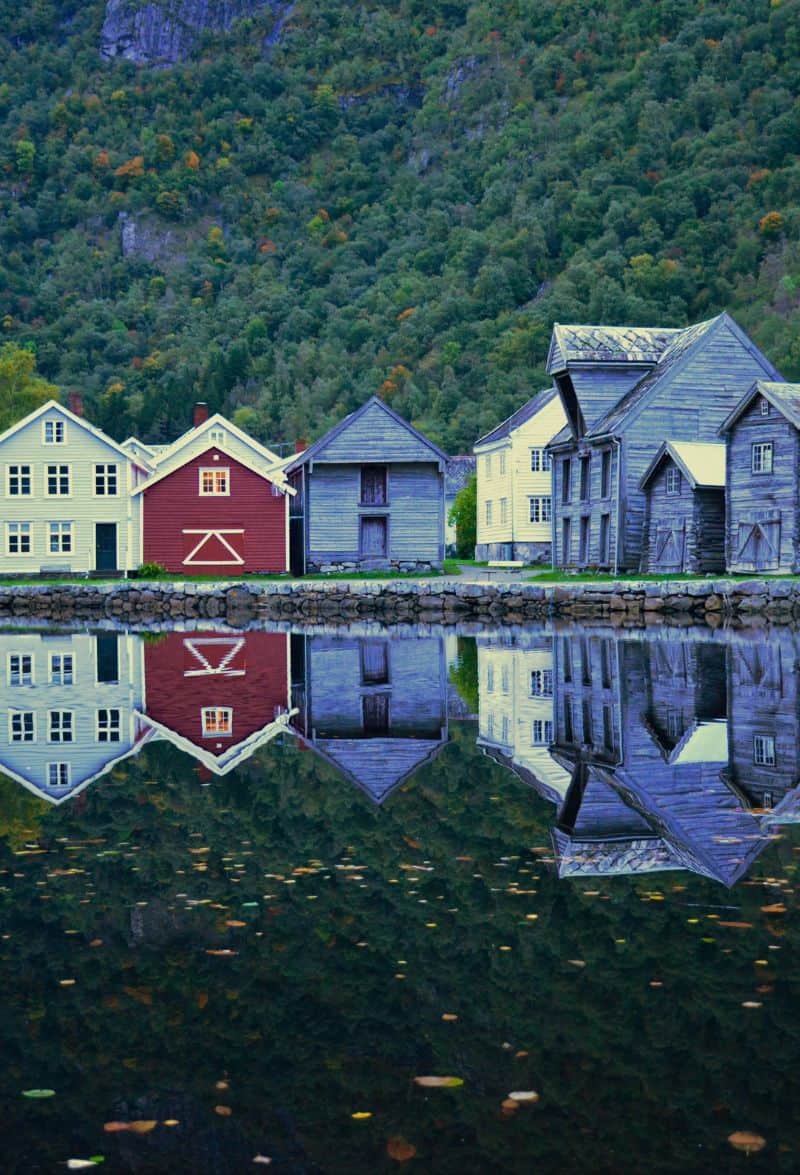
Once in Lærdal, it’s worth stopping at the parking spot with a view out to Gamle Lærdal (pictured above). I also recommend stopping at Sognasmak – a farmers’ market where you can pick up some fresh buns, fruit, cider, and more.
Detour: Borgund Stave Church
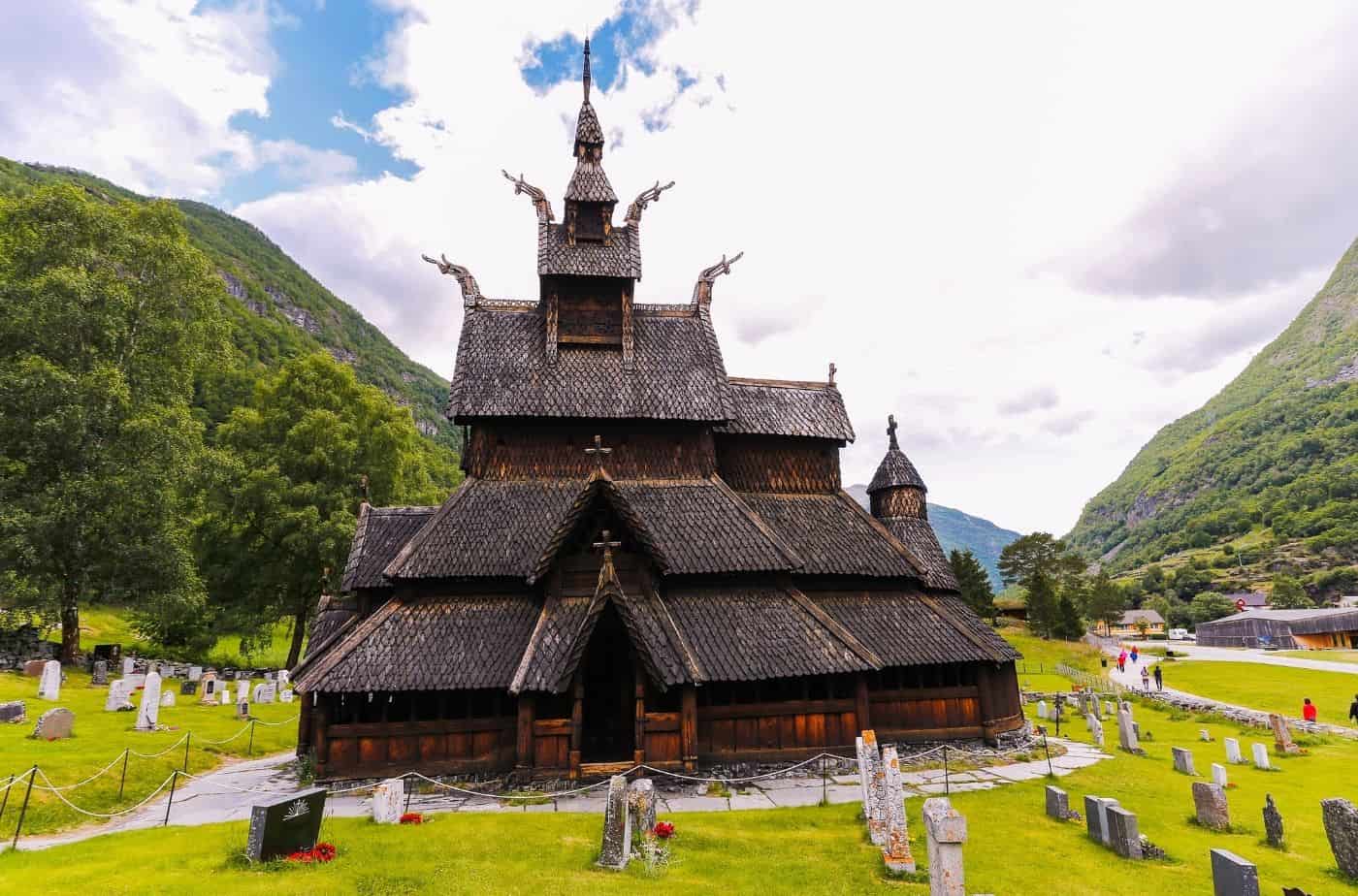
From Lærdal, you can drive to Borgund Stave Church. It is about 30 minutes away one way. It is the most famous and best-preserved stave church in Norway.
If you don’t have time to make it to Borgund Stave Church, you will see a stave church later in the day in Lom.
After leaving Lærdal, you’ll drive along the southern side of the Sognefjord (Norway’s longest fjord) until you reach the village of Øvre Årdal.
Stop 3: Tindevegen
Now it’s time for Tindevegen – a rugged and remote scenic road that links the Sognefjord region with the Sognefjellet mountains. This isn’t one of Norway’s national tourist roads, but it should be! Actually, I take that back. I like the fact that no one knows about it. Except those who have managed to read this far down the article!
The road is quite narrow, but there are plenty of opportunities to pull over for photos. Just before you get to Sognefjellet, you’ll pay a toll.
Stop 4: Sognefjellet
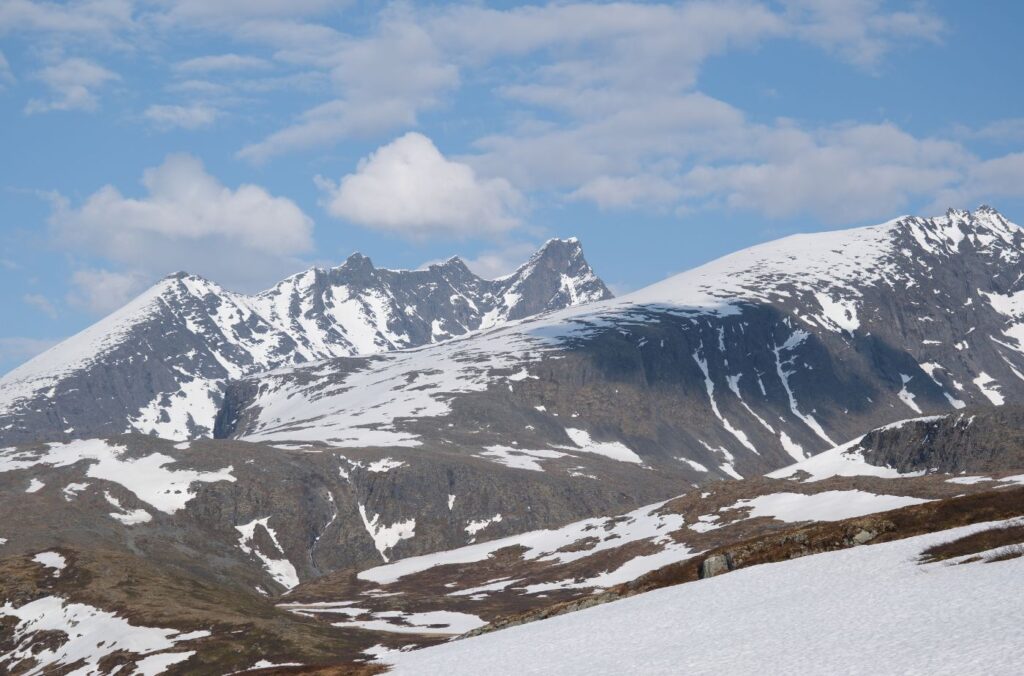
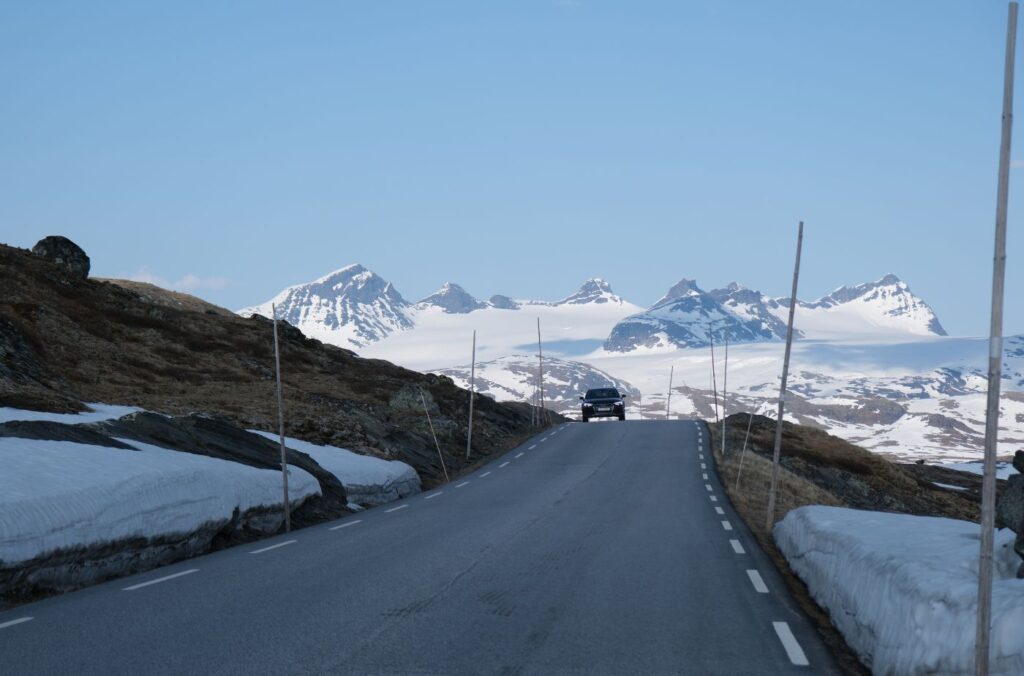
Now it’s time to take your next tourist road, and my personal favourite. The Sognefjellet Tourist Road is the highest road in Northern Europe, reaching heights of 1430m above sea level. It’s possible to see snow here all year round. On a clear day, you’ll be able to see Galdhøpiggen – the tallest mountain in Norway – at 2,469 metres above sea level.
You follow Sognefjellet to Lom.
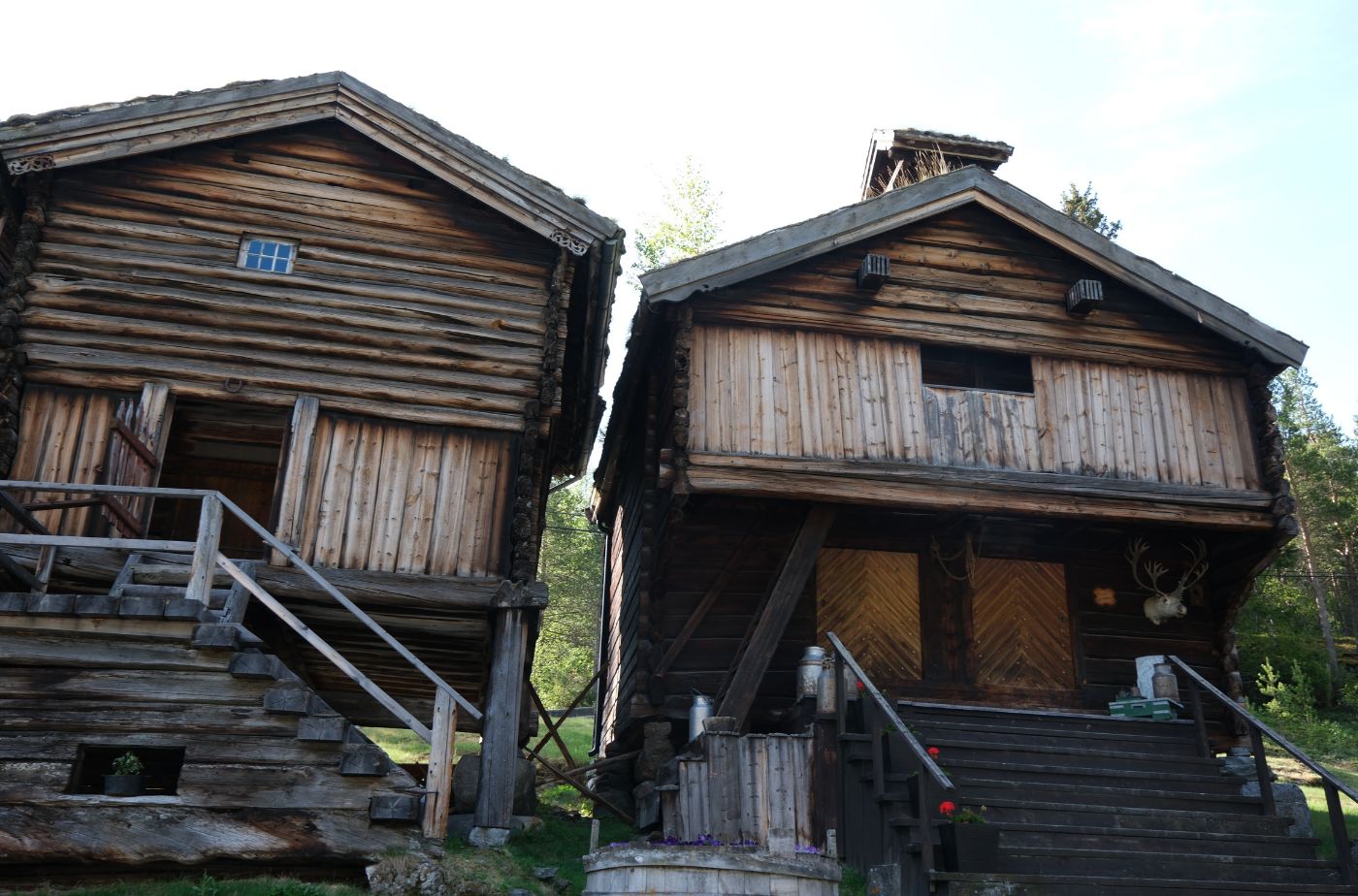
Side note – about 15 minutes from Lom is Røisheim Hotel – possibly my favourite hotel in this part of Norway. It’s a historic guesthouse and inn turned hotel, and the rooms and are styled beautifully. If you want to avoid busy Geiranger, this is an excellent alternative.
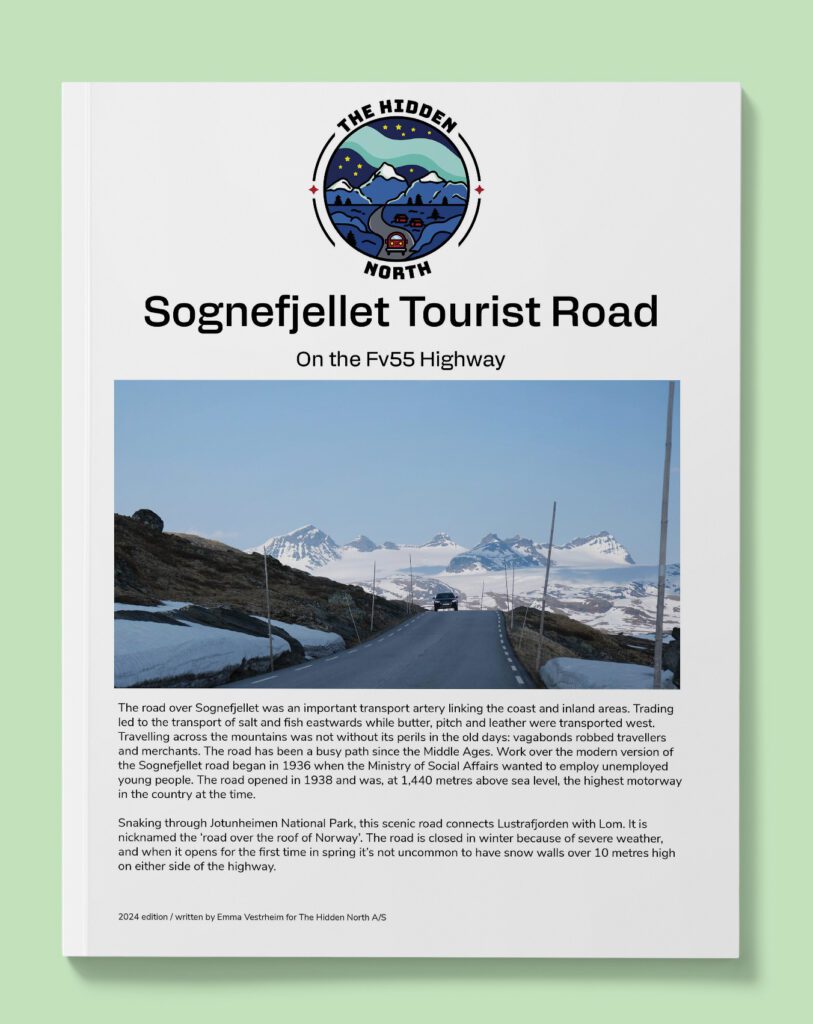
Sognefjellet Tourist Road
You can find my guide to the Sognefjellet Tourist Road by clicking the link below.
Stop 5: Lom
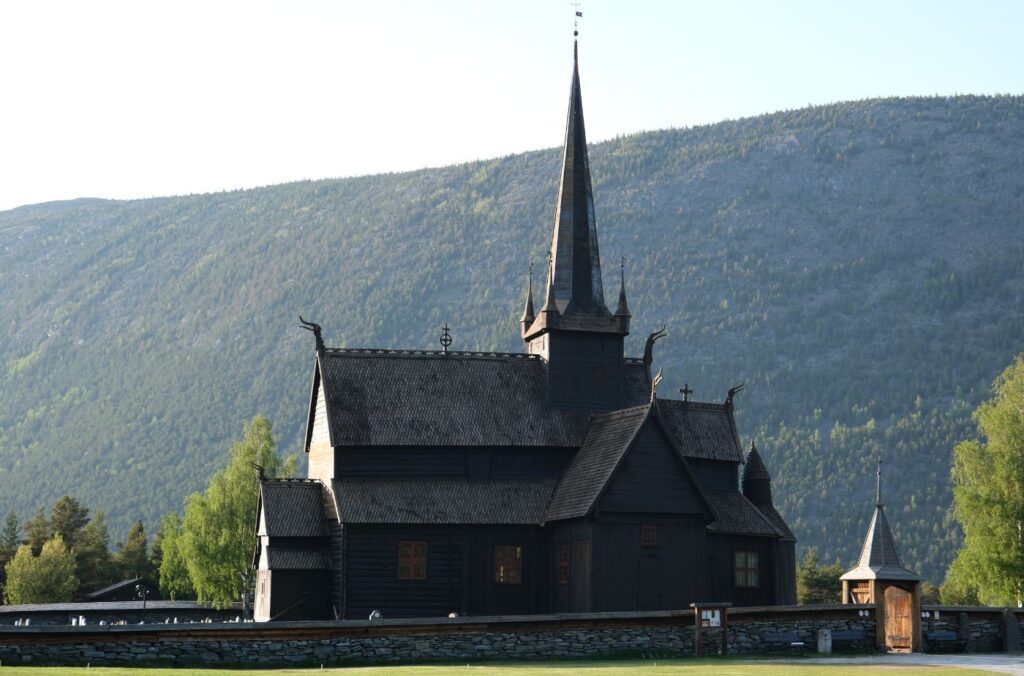
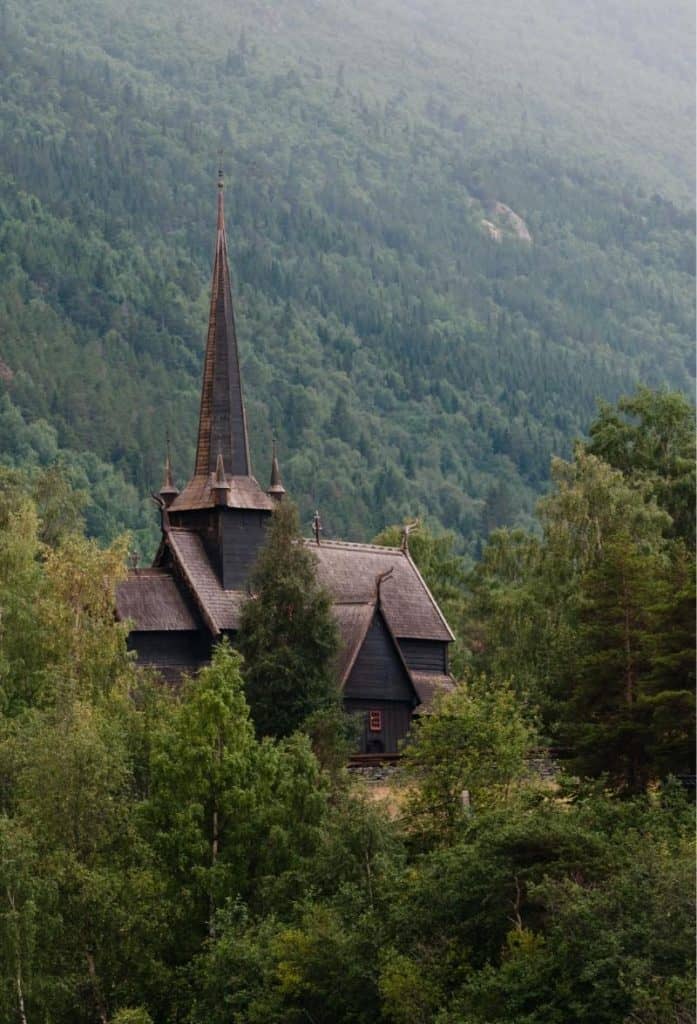
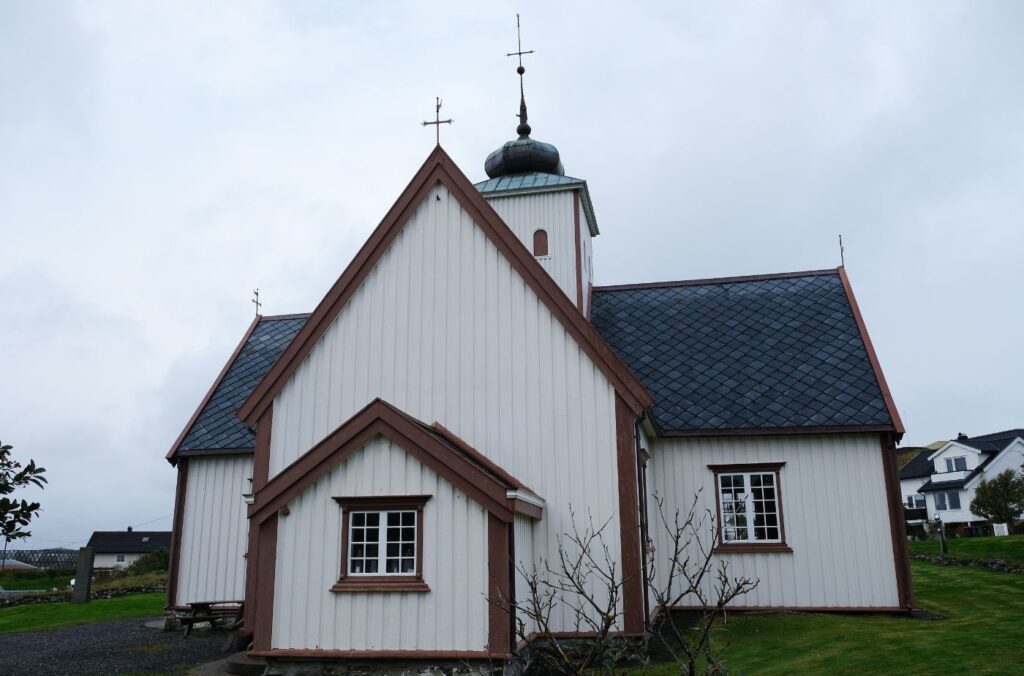
Lom is one of my favourite villages because it is home to two of my favourite things: a bakery and a stave church. Lom Bakery is celebrated as the best bakery in Norway, known for its wood-fired breads, cinnamon buns, and pizza. Lom Stave Church, from the mid-12th century, is one of the oldest and largest stave churches in Norway. It is well-decorated inside, so do take the time to visit.
Why you should visit Lom Stave Church
From Lom, you will be following the Rv15 towards Stryn. Next stop – Geiranger! Unless, of course, you have one more detour in you for the day…
The Rv15 Highway
You can find my guide to the Rv15 highway by clicking the link below.
Detour: Gamle Strynfjellsvegen Tourist Road
This gravel road (open only from June to September) follows the old 19th-century route over the mountains. It’s a narrow, winding drive with waterfalls and mountain views. To get back up to the RV15, take the modern highway through tunnels. I would allow 45 minutes to an hour to do the full detour.
Stop 6: Dalsnibba Viewpoint
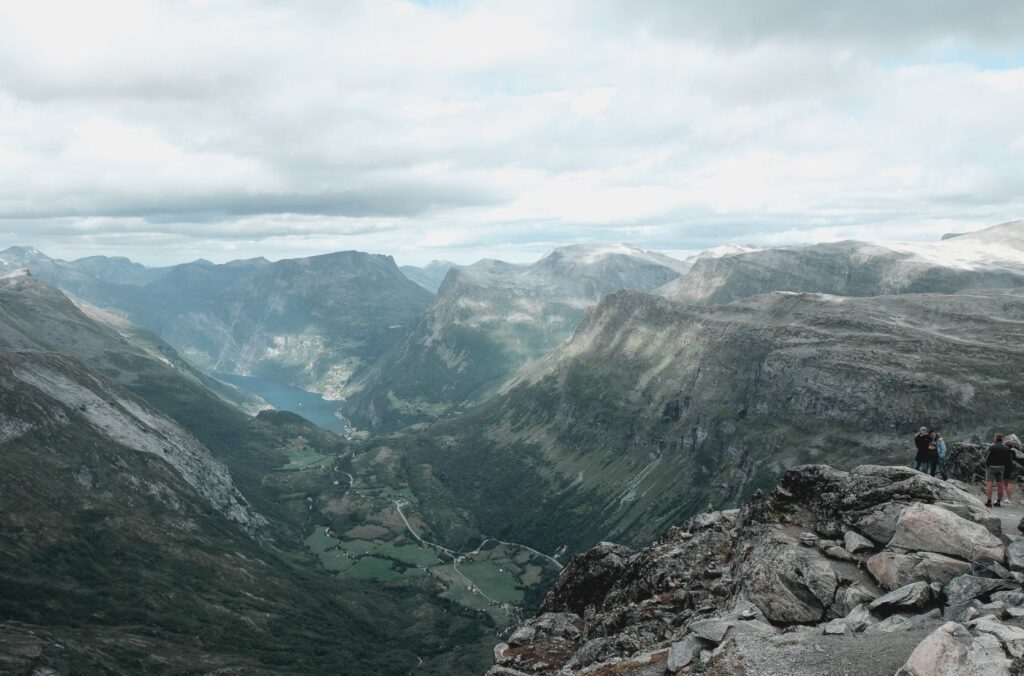
If the weather is nice, it’s worth taking the detour to Dalsnibba Viewpoint before you descend into Geiranger. To get to the viewpoint, you need to pay an entrance fee and wind your way up a rather narrow road; expect big tour buses coming in the other direction!
Stop 7: Flydalsjuvet
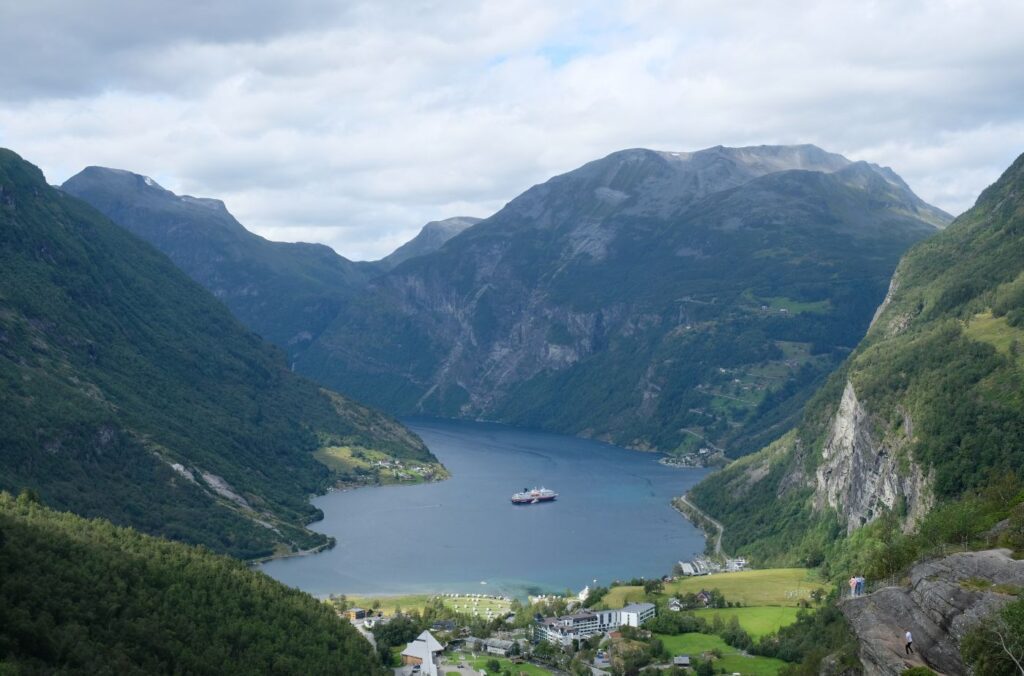
If you don’t make it to Dalsnibba but still want a nice viewpoint before reaching Geiranger, Flydalsjuvet is a free viewpoint overlooking the village of Geiranger. It is very popular with tour buses, so don’t expect to be able to stop there. Don’t worry, you can always come back later in the day when all the groups are gone.
Final Stop: Geiranger
The village of Geiranger has just 250 residents all year round, yet it has become one of the busiest places in summer thanks to the Geirangerfjord, one of two UNESCO World Heritage-listed fjords in Norway.
Expect crowds, buses and cruise ships during the day, but in the evening things will calm down. If you are looking for somewhere to break up the drive so you can go hiking, Geiranger is an excellent place for that.
Where to Stay: Geiranger
My top pick in Geiranger is Hotel Union. It’s a large historic hotel with its own pool and spa, as well as fjord views. The hotel has mountain-view or fjord-view rooms and an in-house restaurant that focuses on local cuisine.
However, there are lots of cabins for rent around Geiranger. I really like Solhaug Fjordcamping down by the fjord.
If you can’t get a place in Geiranger, I recommend staying in Loen (just follow the Rv15 down to Stryn, and then Loen is a 10-minute drive away).
If you want to avoid crowds and would rather have some serenity, then stay at Hjelle Hotel – located a bit out of Geiranger but in a tiny and relatively unknown place.
Be Sure to Try: Geiranger Chocolate
When in Geiranger, the Geiranger chocolate shop is a must! They have some pretty unique flavours of chocolate, such as aquavit, beer, and brown cheese, but you can also get popular chocolate flavours here.
Day 4: Geiranger to Åndalsnes
Fjords: Storfjord, Romsdalsfjord
Tourist Roads: Trollstigen Tourist Road
Fjord Road-trip Drive Time: 2 hours 15 minutes (without stops)
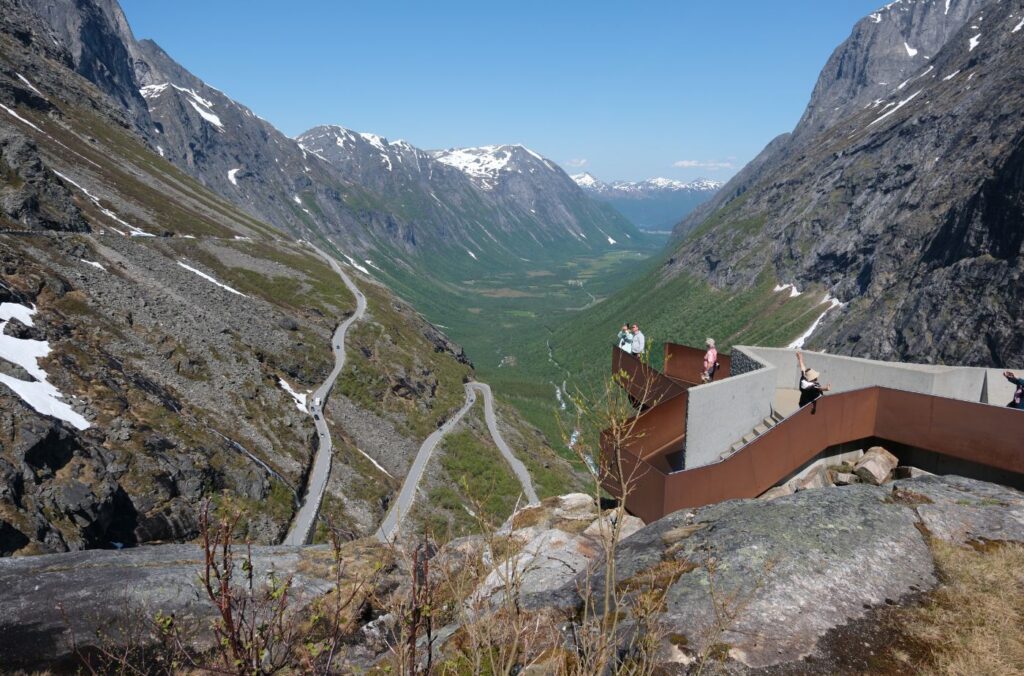
Today is one of the shortest driving days, but this is because you will be taking the Trollstigen Tourist Road, the most famous of all the tourist roads in Norway.
Trollstigen is the highlight of anyone’s road trip to Norway, so today is dedicated to enjoying the drive. Start by leaving Geiranger on the Fv63, taking the Ørnesvingen switchback road up into the mountains (try to leave early to avoid tour buses).
You take the ferry from Eidsdal to Linge, a beautiful fjord crossing. Click here for the ferry schedule.
Trollstigen Tourist Road
You can find my guide to the Trollstigen Tourist Road by clicking the link below.
Stop 1: Valldal
Valldal is a small fjord-side town. Park your car in the centre and head down to the waterfront for some lovely views out to the fjord. The region is known for its berries, so go on the hunt for some! There’s a bakery and some parking at the Muri senter mall.
After leaving Valldal, you drive through an impressive mountain area.
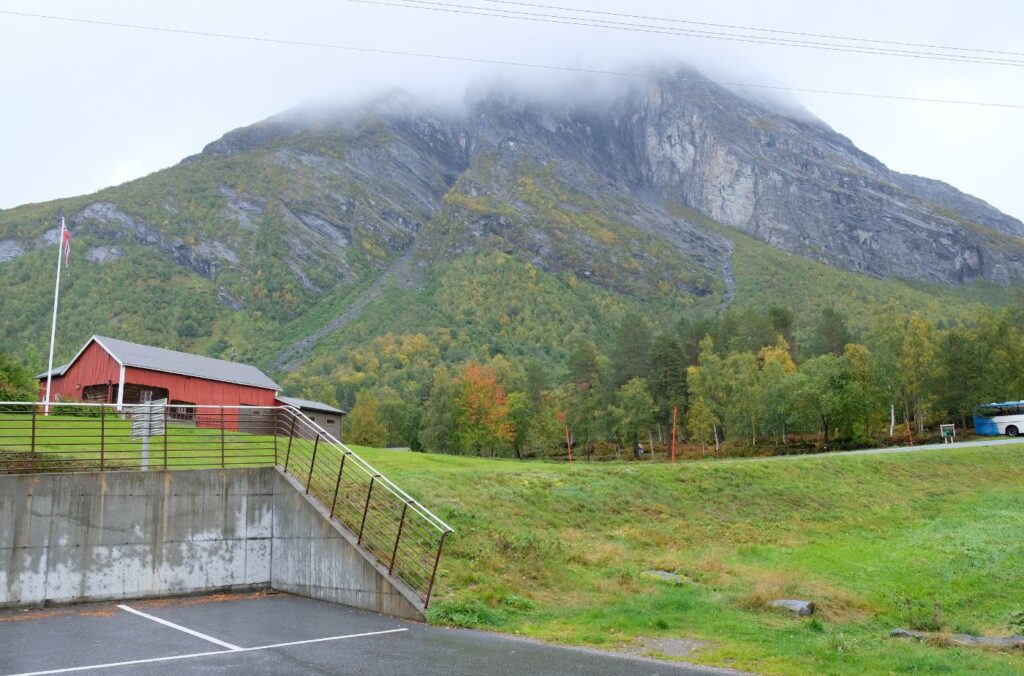
Stop 2: Trollstigen Visitor Centre
Before you descend the famous switchback road of Trollstigen, be sure to stop at the visitor centre.
It will be super crowded if you’re there during the middle of the day in high season, so there is a chance you’ll struggle to find a parking space. You can pick up some souvenirs, have an overpriced coffee, or use the restrooms at the visitor centre. I recommend following the outdoor walking path to a lovely viewpoint down the switchback road.
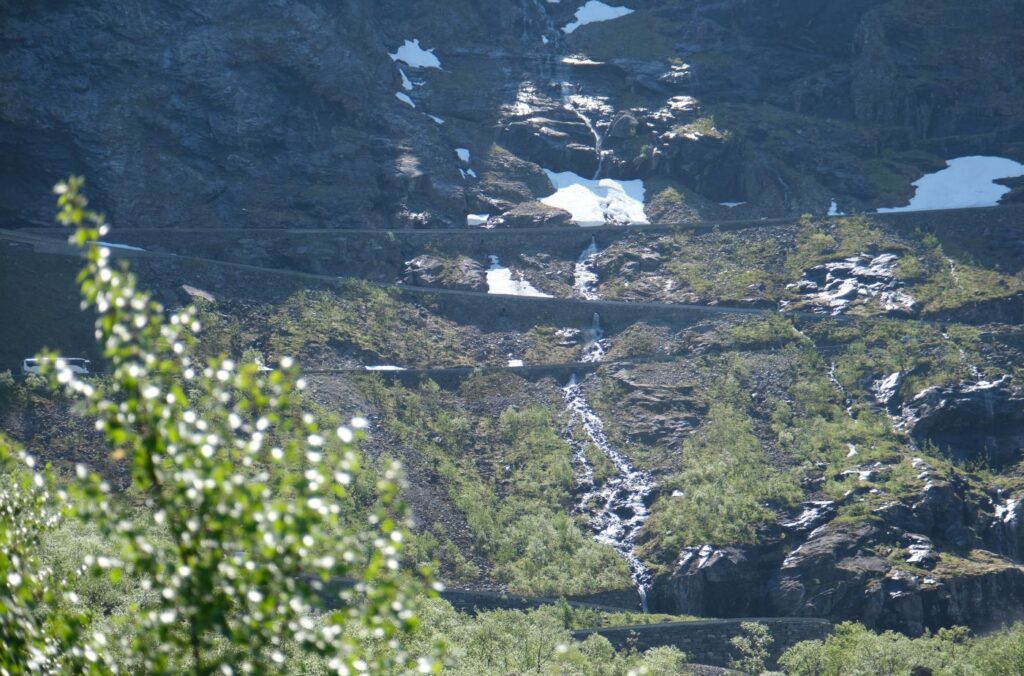
As you go down the road, patience is key. You’ll be passing lots of caravans and tour buses, which will be crowded. There’s not really anywhere to stop as you go down. Be kind and courteous to your fellow drivers!
At the bottom of Trollstigen is another place to stop for photos, though it’s not as scenic.
From the bottom of Trollstigen, it’s a short drive through the valley to Åndalsnes.
Final Stop: Åndalsnes
Åndalsnes is a popular tourist town for adventure seekers heading to the mountains. In the heart of the town you’ll find the Rockclimbing Centre. My personal recommendation is to take the Romsdal Gondola high up the Romsdal peaks for some spectacular views over Western Norway. From there, you can hike or enjoy a nice meal at the restaurant.
If you want to go for a longer drive, you can get closer to the Atlantic Road (for the next day), or take the one-hour drive along the E136. This will take you along Trollveggen – the ‘Troll Wall” – tall, dramatic mountains! You then have to turn around and come back the same way. Alternatively, you can book the Romsdal Train and do the same journey from the comfort of a historic train.
Where to Stay: Åndalsnes
I recommend Hotel Aak, a historic hotel just outside of Åndalsnes. They have an on-site restaurant specialising in local cuisine here.
You can also find many cabins for rent in the surrounding region.
Day 5: Åndalsnes to Molde (via the Atlantic Road)
Fjords: Langfjorden, Fannefjord, Hustadvika Coast
Tourist Roads: Atlantic Road
Fjord Road-trip Drive Time: 4 hours (without stops)
The Atlantic Road is considered a bucket-list item for road-trippers, so I’ve included it in this day. The drive to and from the road isn’t the most beautiful drive; you will drive along the rugged coastline after crossing the Atlantic Road, but otherwise the road itself is uneventful. If the Atlantic Road isn’t something you’re particularly interested in, you can cut out this day and instead have an extra day somewhere else on the journey.
If you are set on doing the Atlantic Road, I recommend getting on the road as early as possible. You can do the Atlantic Road either from Molde to Kristiansund or vice versa (as this guide explains), depending on where you want to spend the night. It’s a five-hour drive to Nordfjordeid from Molde, which is why I’ve written today as I have.
It takes 2.5 hours to get from Åndalsnes to Kristiansund, and you’ll take one ferry – Åfarnes-Sølsnes (click here for the ferry schedule).
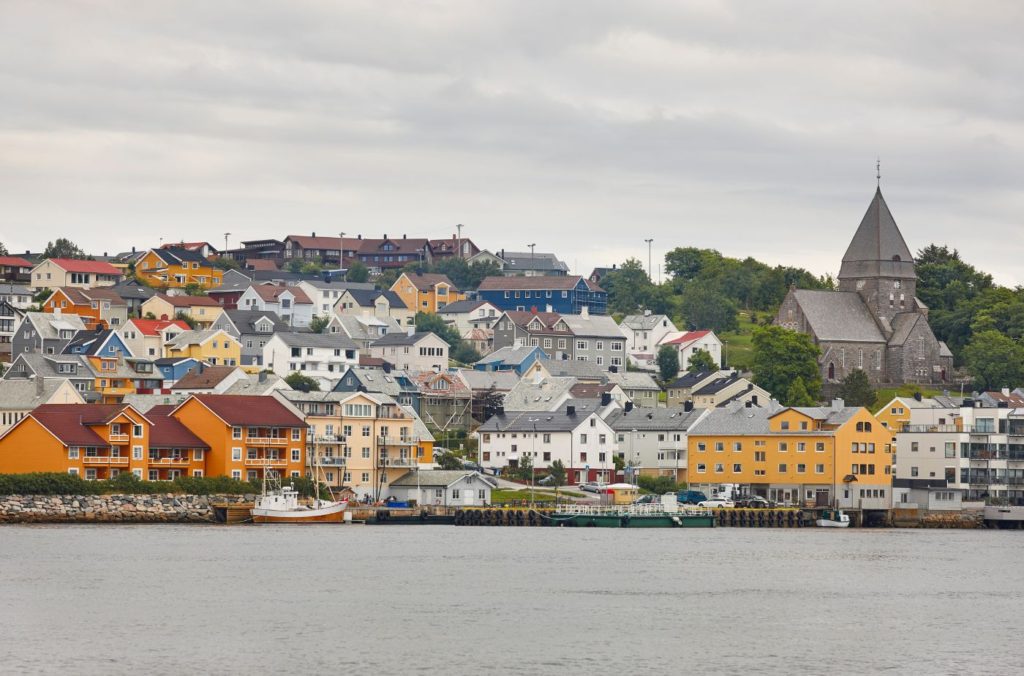
Stop 1: Kristiansund
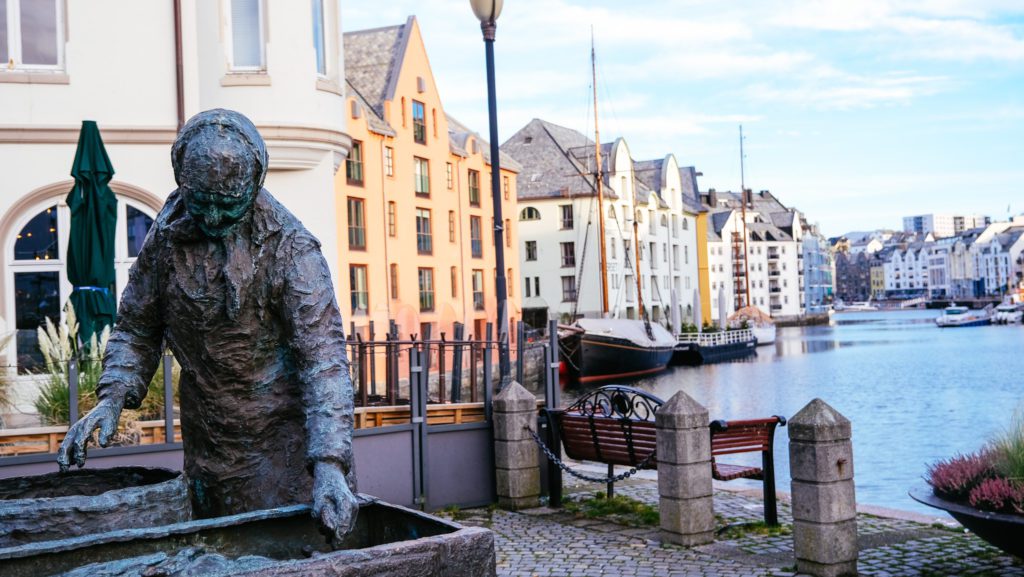
Kristiansund is known as the Clipfish Town. Historically built on the salt-cod (bacalao) trade. In Kristiansund you can visit the Clipfish Museum or see the famous Klippfiskkjerringa statue on the waterfront. For lunch, try local specialities: many restaurants serve bacalao or fresh seafood. You can try, for example, Smia Fish Restaurant.
Stop 2: The Atlantic Road
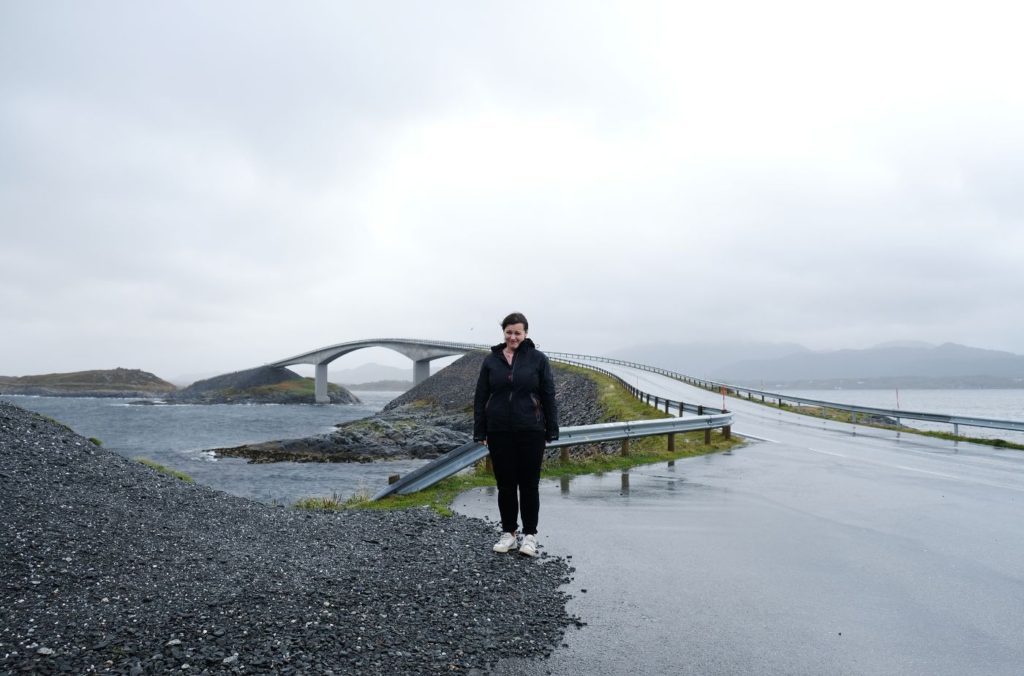
From Kristiansund, head south following signs to the Atlantic Road (the Fv64 highway). The Atlantic Road is an 8km stretch of causeways and iconic arched bridges spanning skerries in the Atlantic. The Atlantic Road has been used in tons of movies and has even been voted the ‘construction of the century’. Just keep in mind it’s only 8km, so blink and you’ll miss it! Stop at the Eldhusøya floating walkway or the Askevågen steel viewing platform for seascape panoramas.
The Atlantic Road (Fv64)
You can find my guide to the Atlantic Road by clicking the link below.
Stop 3: Bud
After completing the Atlantic Road, I recommend continuing the drive along the Hustadvika Coastline (instead of following the Fv64 straight back to Molde). You’ll end up in the village of Bud, which is one of the most historic villages on this stretch of coast.
From Bud, it is only 45 minutes to Molde.
Final Stop: Molde
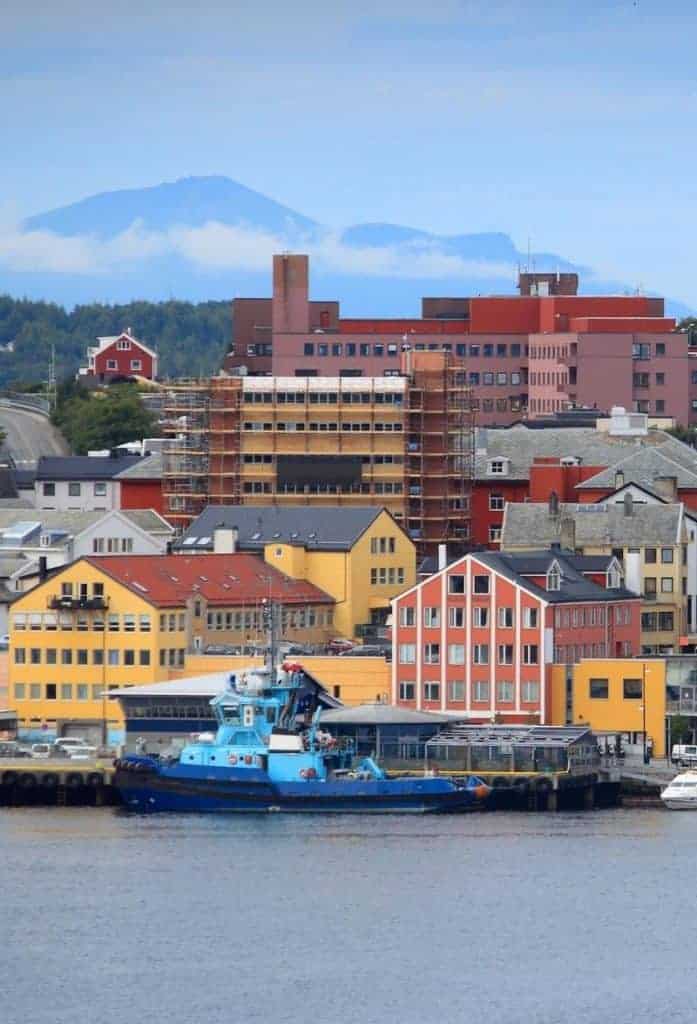
Known as the ‘City of Roses’, Molde is a charming fjord-side town famed for its soccer (football) team and jazz festival. Also, on a clear day, Molde has a lovely view out to 222 peaks forming the Romsdal mountain range.
Where to Stay: Molde
If you don’t mind a longer drive the next day, you can opt to stay in accommodation on the Atlantic Road.
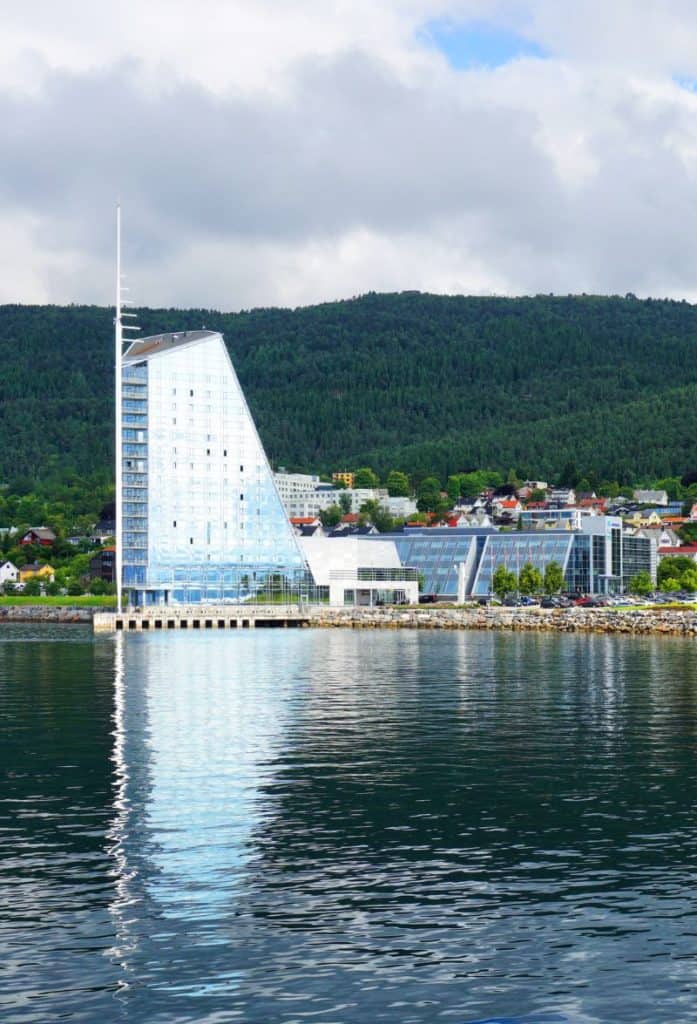
In Molde, you can stay at the Scandic Seilet (pictured above), a new hotel designed to look like a sailing ship with views out to the 222 peaks surrounding Molde.
Day 6: Molde to Øye
Fjords: Storfjord, Hjørundfjord
Fjord Road-trip Drive Time: 3 hours 50 minutes (without stops)
It’s time to start the journey back south to Bergen.
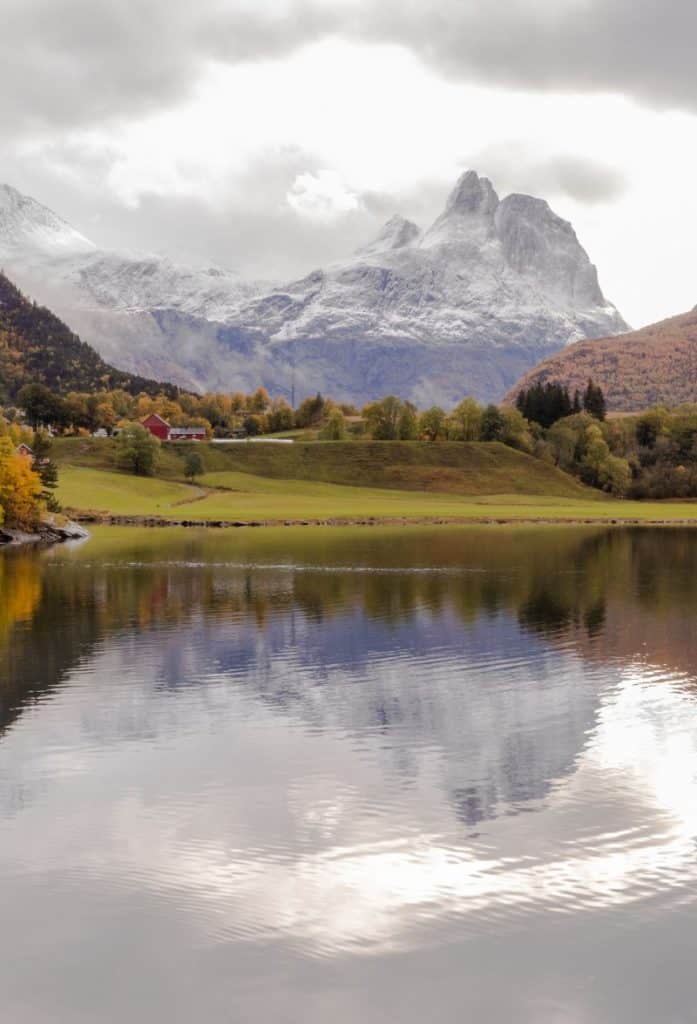
Originally, I wrote this guide with plans to have you end the day in Nordfjordeid, but I can’t have you pass by my favourite fjord – the Hjørundfjord! So, this guide now includes a night along the Hjørundfjord. The ‘main town’ along the fjord is Sæbø, where you can find some nice accommodation. Still, I highly recommend splurging on Hotel Union Øye – it is my favourite hotel in Norway and a unique historic property.
If you are concerned about the long drive back the following day, or the cost of staying at Hotel Union Øye, continue to Loen and spend the night there. Or, you can stay in Hellesylt.
Your day starts with a ferry right out of Molde across the fjord to Vestnes. Click here to view the ferry schedule.
Stop 1: Ålesund
Honestly, stopping in Ålesund is a bit of a detour. But, it’s considered one of the most beautiful towns in Norway and you may want to see what Ålesund looks like.
You can stay on the outskirts of Ålesund and visit Borgund Church (a medieval church) or visit the Sunnmøre Museum, a lovely open-air museum.
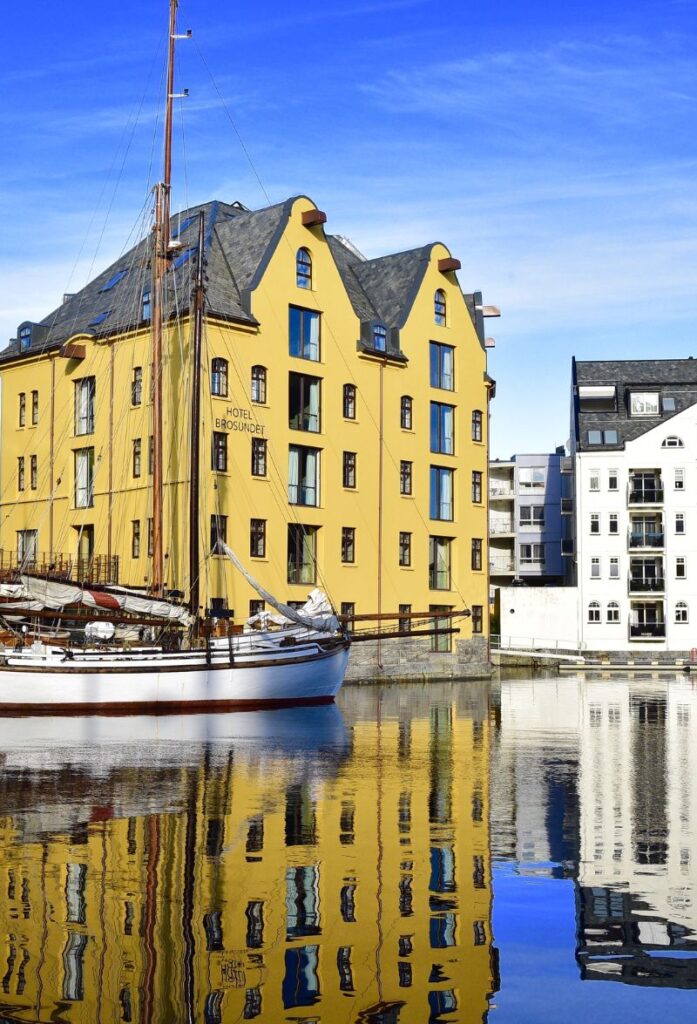
If you decide to head into Ålesund, park at the large underground carpark called Askla (note – costs money!) and then hike up the 418 steps to the top of Mt. Aklsa or go for a stroll around town, admiring the art nouveau buildings.
After leaving Ålesund, you’ll have to take a ferry to get to the Fv60 highway. The ferry runs regularly and it doesn’t take long to get across. You can find the ferry timetable here.
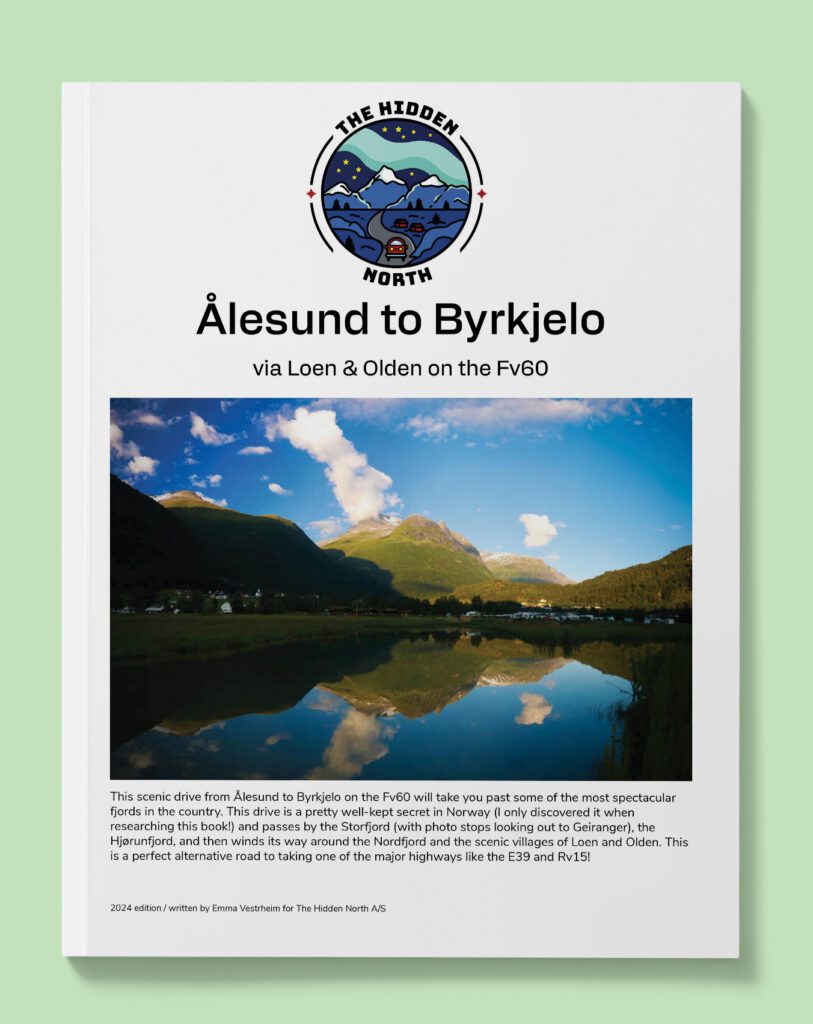
After this, you’ll be driving on the scenic Fv60 highway. This is another one of those highways that I’m surprised hasn’t been turned into a tourist road. It’s so incredibly beautiful! And you are going in the right direction – heading from the rolling hills of the coast to the dramatic mountain peaks further inland.
Stop 2: Stranda
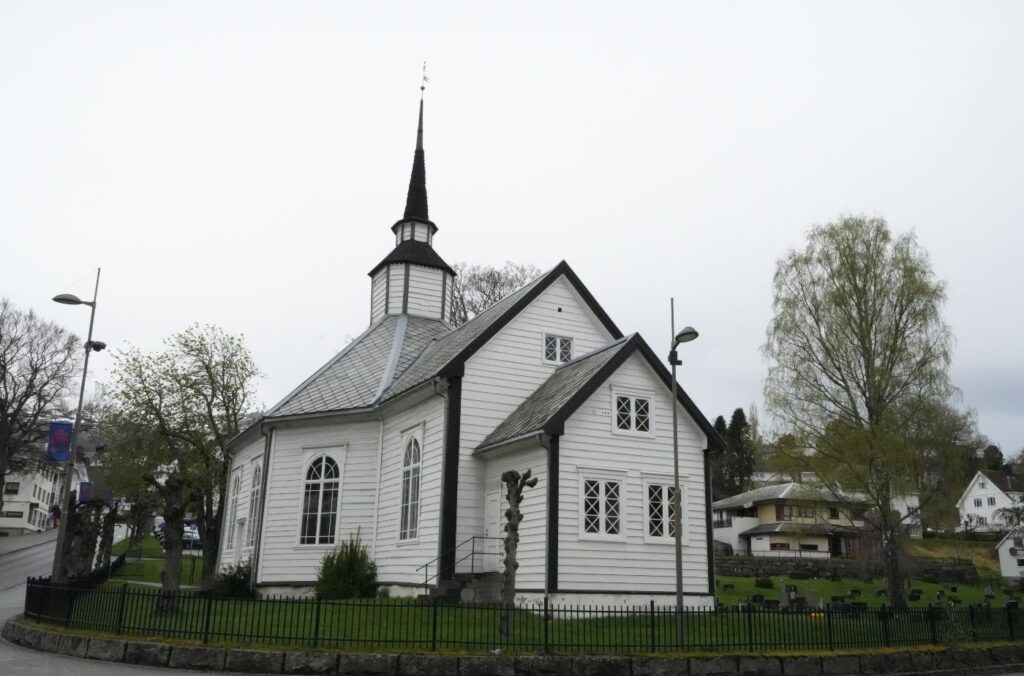
The first town you’ll pass through is Stranda. At Stranda, you can park in the town centre and go for a nice walk. From here, you can see lovely views out to the Storfjord, and there is a historic church in the town centre. Stranda is famous around Norway as it’s where the iconic Grandiosa frozen pizza is made!
Continue along the Fv60.
Stop 3: Ljøen utsiktspunkt
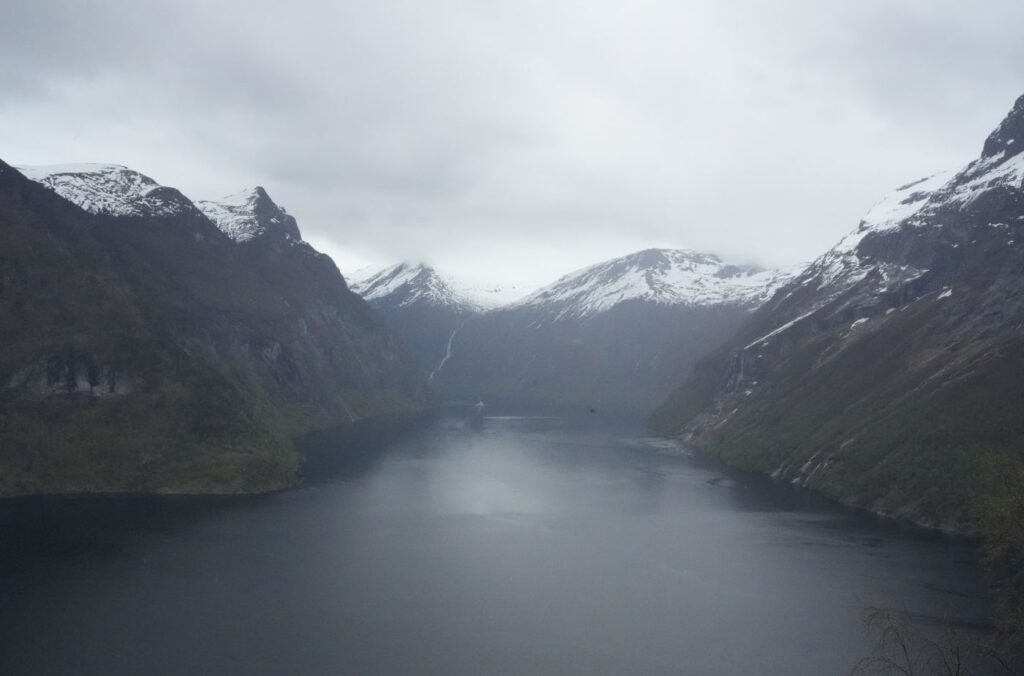
Shortly before you get to Hellesylt, there is a chance to stop at Ljøen utsiktspunkt – a scenic overlook down to the Geirangerfjord.
Stop 4: Hellesylt
Hellesylt is a charming fjord-side town that is often quite busy during the day because of all the visitors heading to Geiranger (Hellesylt has a car ferry to Geiranger). If it’s not too busy on your visit, you can park in the town centre and go for a nice walk. One of the Mission Impossible movies was filmed here, and in the town centre is the motorbike Tom Cruise used! Very cool! There’s also a Devold of Norway outlet store (merino wool clothing) and some souvenir shops.
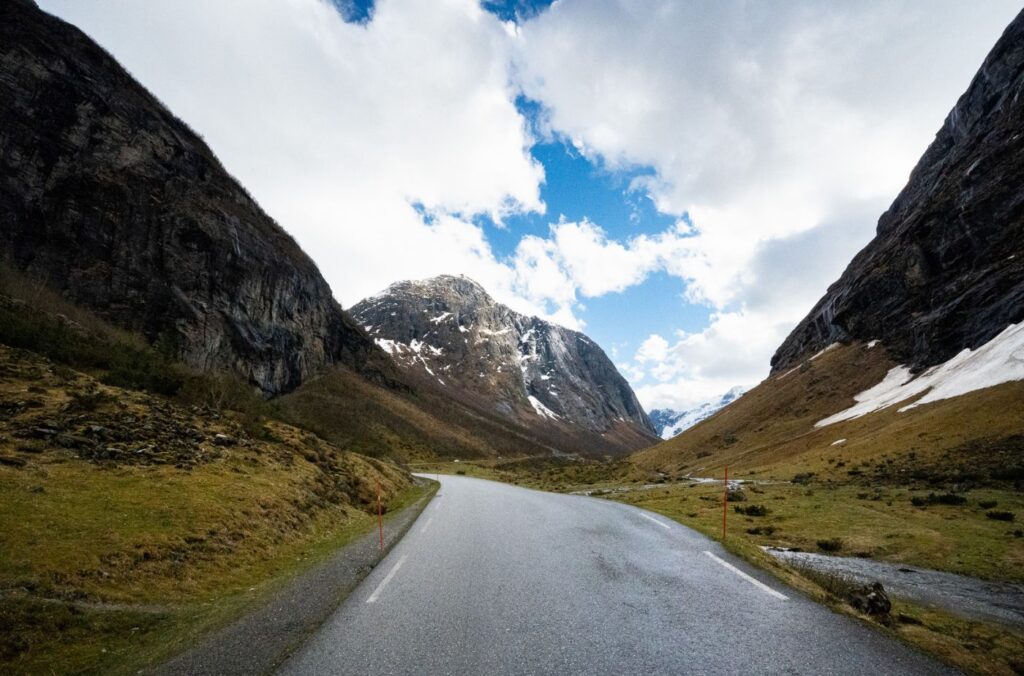
After leaving Hellesylt, you’ll continue on the Fv60 for a short while before reaching a turn to the Fv655. This road is incredible, and it’s worth stopping where you can.
Stop 5: Stavbergsetra or Urasetra
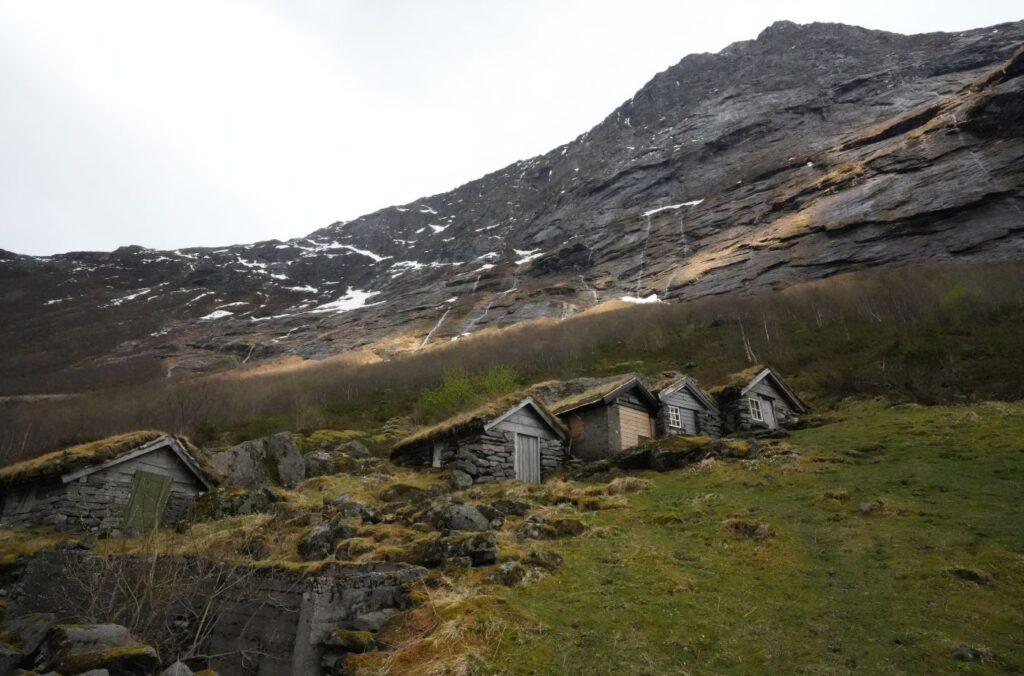
As you drive down the Fv655 towards Øye, you can stop at either of the ‘setra’. These setra are historic summer mountain farms where the dairymaids would stay with the cows. They have been well-preserved and are easily accessible on the side of the road.
Final Stop: Øye
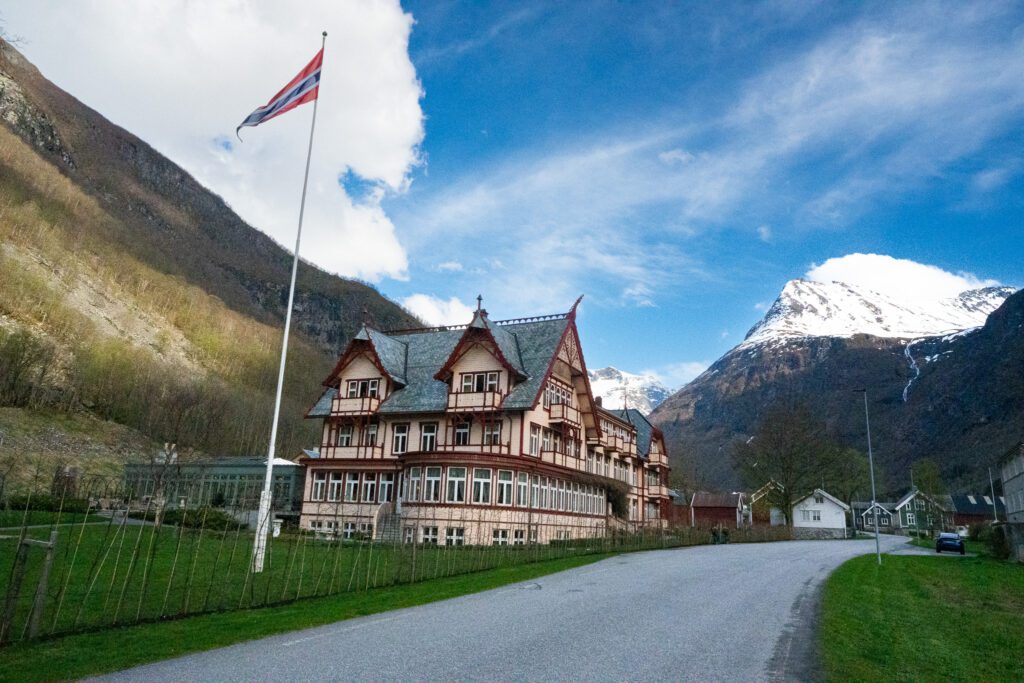
Øye is a tiny village located at the end of the Hjørundfjord, a rather unknown but beautiful fjord. In Øye you’ll find the historic Hotel Union Øye, a 19th century hotel known for its lavish guests (Edvard Grieg, Roald Amundsen, etc) and well-preserved rooms.
Where to Stay: Øye
I’m not going to pretend Hotel Union Øye isn’t expensive, because it is. If you can afford to splurge on one night here, I guarantee you won’t regret it.
However, if the price is just too high for you, or the rooms are sold out, then I recommend following the Fv60 to Loen, where you can book a night in a cabin or at Hotel Alexandra. It will also make your drive time back to Bergen a little quicker the next day.
Hotel Union Øye has a high-end restaurant specialising in local cuisine.
Day 7: Øye to Bergen
Fjords: Nordfjord, Sognefjord
Fjord Road-trip Drive Time: 6 hours (without stops)
I can’t believe it – it’s already day 7! Time to head back to Bergen. You’ll continue driving on the scenic Fv60 until you meet up with the E39, which leads you back to Bergen.
You start your day by taking the Fv655 back to the Fv60, and then follow the highway to Loen.
Stop 1: Loen
Loen is a well-known tourist town due to its location on the Nordfjord and close to some glaciers. You may see cruise ships here (or at Olden) during the day, and there can also be some traffic.
If you have time (you should do it!), take the Loen Skylift for an amazing view over the fjord and surrounding region.
In the neighbouring Olden, you can take the 45-minute drive to view a glacier at Briksdalsbreen. Honestly, I did this in April and found it was a bit of a waste of time – the glacier has retreated so much that it’s far from impressive – but it may interest you.
After leaving Loen, you’ll continue along the fjord to Utvik, where you then leave the fjord behind and take a switchback road up the mountain. There’s a spot to stop for photos (very popular with tourists) and then you continue to Byrkjelo, where you turn onto the E39 highway. You’ll follow the E39 all the way back to Bergen.
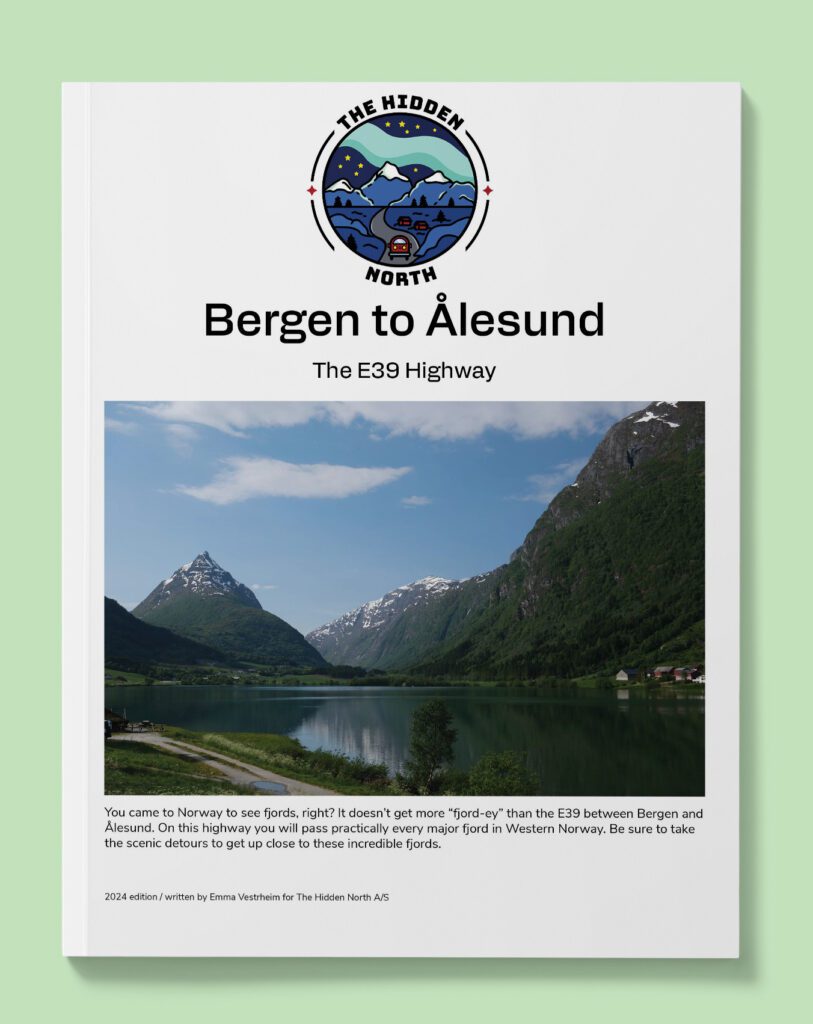
The E39 Highway
You can find my guide to the E39 highway by clicking the link below.
Stop 2: Skei
Skei is a popular rest stop on the drive from Loen down to Bergen. Here you’ll find a great souvenir shop, Audhild Viken, where they also serve nice lunches. The cafe Brunsj & Briller is excellent as well for lunch.
After leaving Skei, you’ll drive along the northern shore of the Jolstravatnet lake.
Stop 3: Førde
I’ve saved the best to last. Okay, not really. But Førde is a town you must drive through on the way back to Bergen. It is considered to be the ugliest town in Norway (according to Norwegians), but it is a good spot to stop if you need to rest. Just out of town is the Sunnfjord Museum, a lovely open-air museum.
You’ll continue on the E39 to the Sognefjord, where you take your last ferry for the trip. The ferry from Lavik leaves regularly, so you won’t be waiting long to cross. You can view the ferry timetable here.
The last stretch to Bergen is rugged, mountainous, remote, but very scenic!
Wrapping Up the Ultimate 7 Day Fjord Road-trip
I hope this guide has given you some inspiration and ideas for making a fjord road trip work. As you can see, there is a lot of driving involved. If you want to do it in 7 days, that’s fine, but you will be in the car often. If you can, consider adding a few nights in some towns of your choice so you can slow down, do some hikes, or enjoy the scenery more leisurely.