
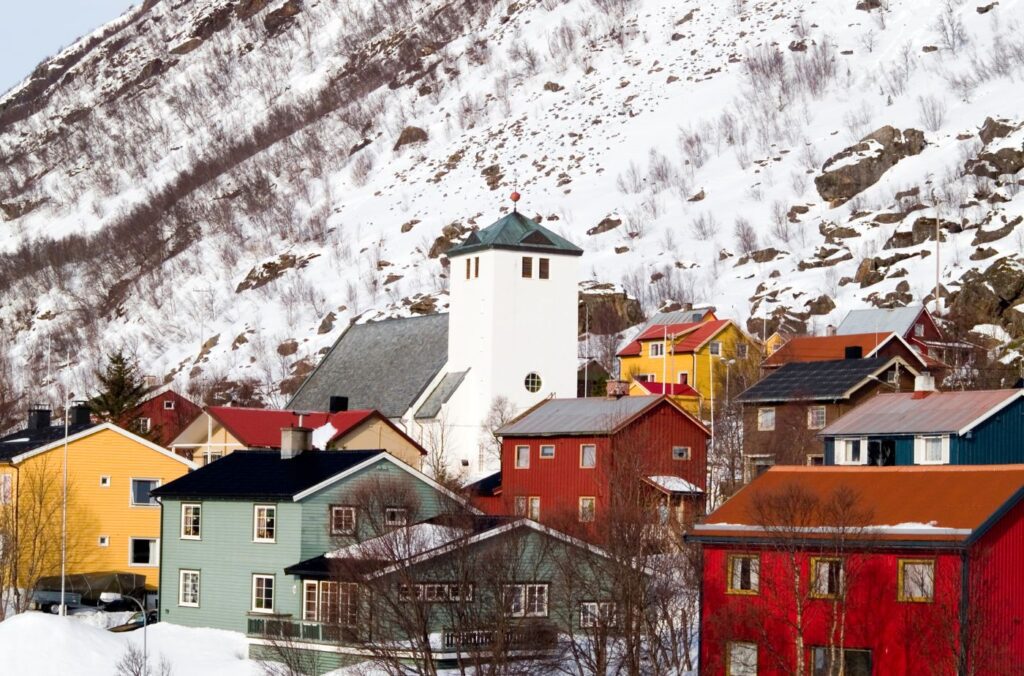
The fishing community Øksfjord lies at the foot of the mountain Grasdalsfjellet (830m). Almost half of the municipality lived in Øksfjord. Øksfjord was connected via an open year-round road connection with the rest of the mainland by a 4252m long tunnel in 1986. The rest of the municipality’s population lives in smaller communities along the coast of Lopphavet.
Latitude: 70.1 degrees north
Population: 496
Hottest Month: July
Coldest Month: February
Wettest Month: October
Windiest Month: February
Loppa Municipality
Here’s an overview of some of the best things to see and do in Øksfjord
Øksfjord Church is one of the town’s most recognisable landmarks, overlooking the harbour and surrounding fjord landscapes. The modern wooden church reflects the simple architectural style common throughout northern Norway while serving as an important gathering place for the local community. Visitors can enjoy peaceful coastal views and experience the quiet atmosphere of this small Arctic settlement. During winter, the church and harbour are especially atmospheric beneath snow and northern lights.
Øksfjordjøkelen is one of Norway’s few glaciers flowing directly towards the sea and one of the region’s most dramatic natural attractions. The glacier rises above steep fjords and rugged mountains, creating spectacular Arctic scenery. Guided hikes and boat excursions allow visitors to experience the glacier from both land and water during summer. The remote location gives the area a true wilderness atmosphere rarely found elsewhere in Europe.
Looking to go for a hike or take part in a unique experience? Here are our recommendations!
Loppa Island, located offshore from Øksfjord, is known for its ancient fishing history and dramatic coastal scenery. Archaeological discoveries show that people have lived in the area for thousands of years, connected to Arctic fishing and maritime trade. Today, visitors can explore quiet coastal landscapes, abandoned settlements and birdlife-rich cliffs. The island offers a sense of isolation and untouched Arctic nature.
Sør-Tverrfjord is a remote fjord settlement accessible by boat from Øksfjord and surrounded by dramatic mountain scenery. The area offers excellent hiking, fishing and opportunities to experience traditional Arctic coastal life far from major tourism routes. Quiet beaches, abandoned fishing sites and steep cliffs create striking landscapes throughout the fjord. The remoteness of the area is part of its appeal.
Follow our road-trip guides for scenic trips around Øksfjord
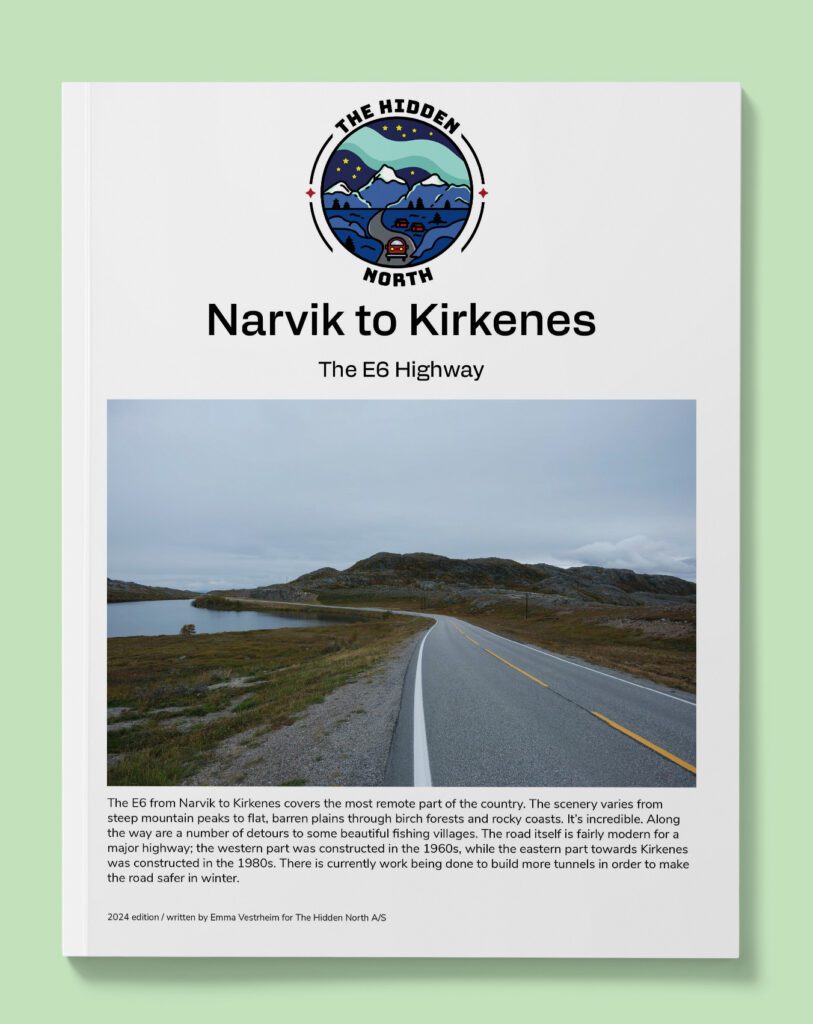
The E6 highway is the longest highway running through Norway, beginning south of Oslo and ending at Kirkenes. This stretch of the E6 covers the entire length of Arctic Norway, passing by and including some spectacular remote places.
Watch our YouTube videos featuring Øksfjord
Øksfjord has long been shaped by fishing, maritime trade and life along Norway’s rugged Arctic coastline. Coastal communities throughout the Loppa region depended heavily on cod fisheries and seasonal trade routes connecting northern Norway with the rest of Scandinavia and Europe. Fishing villages developed around sheltered harbours where boats could safely navigate the often harsh conditions of the Norwegian Sea. Archaeological discoveries on nearby islands also show evidence of human settlement stretching back thousands of years.
The region has historically been influenced by Norwegian, Sami and Kven cultures, all of which contributed to local traditions, livelihoods and ways of life. Fishing, small-scale farming and coastal transport remained central to daily life well into the modern era. During World War II, parts of Finnmark suffered major destruction and forced evacuations, affecting many communities across the region.
Today, Øksfjord remains a small but important coastal settlement where fishing and maritime traditions continue alongside growing interest in Arctic tourism. The surrounding landscapes and isolation continue to shape local identity and lifestyle.
Modern life in Øksfjord revolves around fishing, coastal living and close connections to nature. The community remains small and quiet, with daily life strongly influenced by weather, seasons and maritime activity. Fishing boats continue to operate from the harbour while ferries and Hurtigruten ships connect the settlement with wider parts of northern Norway.
Tourism has slowly increased as more travellers seek authentic Arctic experiences away from larger destinations. Visitors come for glacier excursions, northern lights, wildlife and opportunities to experience traditional fishing village life. Despite this growth, Øksfjord has maintained its peaceful atmosphere and strong local character.
Outdoor recreation is deeply woven into everyday life throughout the year. Residents regularly fish, hike, snowmobile and travel by boat through the surrounding fjords and mountains. The combination of remoteness, dramatic scenery and Arctic culture gives Øksfjord a distinctive identity within Finnmark.
Fly: The nearest regional airport is in Hammerfest, with additional connections available through Alta Airport. Travellers typically continue to Øksfjord by ferry, bus or car through Finnmark’s coastal region.
Drive:Øksfjord can be reached by road through northern Norway’s scenic Arctic landscapes, combined with ferry connections. The drive offers dramatic views of fjords, mountains and open coastal areas throughout Finnmark.
Train: There is no railway connection in Finnmark. Travellers usually combine flights, buses and ferries when reaching the region.
Ferry: Ferries are essential for transport throughout the Loppa region and connect Øksfjord with nearby islands and coastal settlements. Hurtigruten coastal ships also provide scenic travel opportunities through northern Norway.
There are express boats connecting Øksfjord to Hammerfest.
Øksfjord itself is compact and easily explored on foot. Boats and ferries are important for reaching nearby islands and remote fjord communities. Rental cars are useful for exploring nearby areas with roads, while guided boat tours offer access to glaciers and coastal wilderness. Snowmobiles are also commonly used during the winter months.
Cafes & Bakeries
Restaurants
Støa kafé og spiseri is the main eatery in town.
High End & Unique Eats
Camping
Cabins & B&Bs
Chains & Mid-Range
High End & Unique Properties
Polar night until 19 January
Average Temperature: -3C (27F)
Sunrise: 8:09am
Sunset: 3:21pm
Average Temperature: -3C (26F)
Sunrise: 5:51am
Sunset: 5:29pm
Average Temperature: -2C (29F)
Sunrise: 4:22am
Sunset: 8:41pm
Average Temperature: 1C (34F)
Midnight sun from 16 May
Average Temperature: 5C (42F)
Midnight sun
Average Temperature: 8C (47F)
Midnight sun until 28 July
Average Temperature: 12C (53F)
Sunrise: 3:25am
Sunset: 9:39pm
Average Temperature: 12C (53F)
Sunrise: 5:43am
Sunset: 7:05pm
Average Temperature: 8C (48F)
Sunrise: 7:46am
Sunset: 4:44pm
Average Temperature: 4C (39F)
Sunrise: 9:28am
Sunset: 1pm
Average Temperature: 1C (33F)
Polar night
Average Temperature: -1C (30F)