
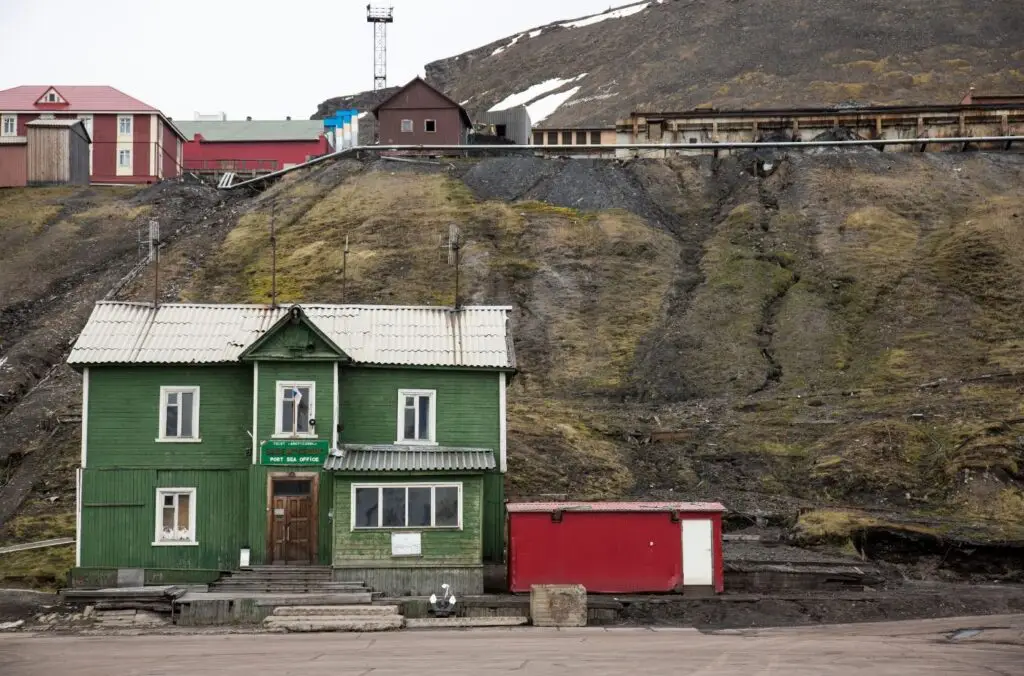
Barentsburg is a remote Russian mining town on Spitsbergen Island offering an intriguing mix of Arctic wilderness and Soviet-era buildings. The town is still populated, and it is possible to visit there with a guided tour.
Latitude: 78 degrees north
Population: 297
Here’s an overview of some of the best things to see and do in Barentsburg.
Barentsburg’s Soviet legacy is on proud display. A bronze bust of Vladimir Lenin stands in the central square, gazing over Grønfjorden, as the world’s second-northernmost Lenin statue (after Pyramiden). In front of the bust is a red star with the slogan “Miru Mir” (“Peace to the World”) – locals note that when this star reappears in late January, it signals the end of the polar night and return of daylight.
Discover Barentsburg’s rich history at the Pomor Museum. This small museum (housed in the Cultural Centre) showcases artifacts from early Russian Pomor explorers, a collection of minerals and Arctic wildlife taxidermy, and even a dinosaur footprint found on Svalbard. Exhibits cover the history of coal mining, WWII events, and everyday Soviet-era life. Exhibits cover the history of coal mining, WWII events, and everyday Soviet-era life. It’s a fascinating hour-long journey through Arctic heritage – entry is inexpensive (~25 NOK) and guided tours are sometimes available.
Visit the world’s northernmost Russian Orthodox chapel, a tiny wooden church built in 1996 on a hillside above town. This quaint chapel was constructed to commemorate 141 people who died in a 1996 plane crash and 23 miners killed in a 1997 mine accident. It’s an active chapel (so be respectful if locals are praying) and a symbol of hope and remembrance. The interior is simple and peaceful, and from the chapel, you get great views of the settlement below.
Barentsburg is home to the world’s only active coal mine that offers guided tours to tourists. This truly unique experience takes you underground into the working Mine #3. Outfitted in coveralls, boots, hardhat with headlamp, and a self-rescuer breathing device (all provided), you’ll follow veteran miners down into the tunnels. The tour runs daily each morning (by prior arrangement) and lasts 2–3 hours. At about 700 NOK per person in a small group, it’s an invaluable insight into the gritty life of a coal miner. You’ll witness the mine’s machinery, coal seams, and the techniques used to carve out coal in this harsh environment. Guides (often miners themselves) share stories of the mine’s history, from its Soviet heyday to modern challenges. Half a kilometre below ground, you’ll sense the eerie stillness punctuated by dripping water and distant machinery noise.
It feels like stepping through a portal to Barentsburg’s past and present simultaneously. Safety is paramount: a thorough briefing is given and all participants sign in, plus no personal devices or photography are allowed in the mine (your guide will take an official photo of you inside).
This tour is absolutely one-of-a-kind – no other tourist destination lets you venture into an active Arctic coal mine, making it a must-do for intrepid visitors.
Looking to go for a hike or take part in a unique experience? Here are my recommendations!
In the dark season and spring, guided snowmobile tours are the most thrilling way to reach and explore Barentsburg. From mid-February to early May, operators run snowmobile trips from Longyearbyen across frozen fjords and mountains to Barentsburg.
Options range from a full-day excursion (approx. 60–70 km each way) to overnight expeditions. For example, a one-day guided tour will whisk you over glaciers and through valleys in about 4 hours (with scenic stops), culminating in a Barentsburg town visit. Longer trips like the “Boundless Arctic” 3-day safari include Barentsburg plus remote sights. Riding a snowmobile under the polar night sky or the pastel “sunny winter” daylight is unforgettable – you may even spot polar bear tracks or a wandering reindeer en route. All groups are led by experienced guides (with safety gear and rifles), and warm suits and helmets are provided. It’s an adrenaline-pumping journey across Svalbard’s snowscapes, ending with a warm meal or celebratory vodka in Barentsburg.
From early June through September, daily boat tours connect Barentsburg with Longyearbyen via the open sea. These range from comfortable day-cruise ships (2–3 hours each way) to high-speed RIB boats (just ~1 hour each way).
Most tours include a guided walk in Barentsburg plus additional nature sights. A popular itinerary is the Barentsburg & Esmark Glacier cruise – on the approach, the boat detours into Ymer Bay so you can marvel at the towering front of Esmarkbreen glacier, often with seals lounging on ice floes.
Some trips also swing past Grumant (an abandoned Soviet mining outpost on Isfjorden’s coast) and the Fuglefjella bird cliffs, home to thousands of seabirds and the occasional puffin in summer.
Once in Barentsburg, a local guide usually greets visitors at the pier and leads a walking tour of the town’s highlights (translated into English). You’ll climb the harbour steps, see the Lenin statue, visit the museum or chapel, and learn about daily life. After the tour, enjoy some free time – perhaps visit the pub or souvenir shop – before the return voyage. Cruising the fjords offers chances to see whales (minke or beluga are sometimes spotted) and walrus in the water, so keep your camera ready. Boats operate regularly in the midnight sun period, making this the easiest way for summer travellers to experience Barentsburg in a day.
Olaf Mountain Trail (Olavsvarden): A rewarding medium-difficulty hike for fit walkers. This trail leads up Grønfjordfjellet to Olav’s Peak (520 metres elevation). It’s about 7–8 km round-trip (2.5–3 hours) with a steady uphill climb to a stone cairn at the summit. Along the way, you’ll pause at a viewpoint ~520 m above sea level overlooking Barentsburg, Grønfjorden and the Greenland Sea coast. On a clear day the panoramic vistas are sensational – bring a camera! In winter, this becomes a guided snowshoe hike (if snow conditions allow) for a magical ascent under the polar twilight. The trail is marked and rated T2 (moderate) with some steep sections. Your guide will usually carry a rifle (as polar bear protection), so you can focus on enjoying the trek and sipping a hot drink at the top while soaking in the Arctic silence
Barentsburg’s story begins with exploration in the Spitsbergen archipelago’s lawless days. The town is named after Dutch explorer Willem Barentsz, who sighted Svalbard in 1596. Coal was the draw that founded the settlement – a Dutch mining company established the outpost around 1920, calling it Barentsburg and starting small-scale mining.
In 1932, as Arctic coal became strategic, the Dutch sold Barentsburg to the Soviet state trust Arktikugol (“Arctic Coal”). From then on, Barentsburg became a Soviet frontier town on Norwegian soil, and mining ramped up under Soviet planning. The Svalbard Treaty of 1920 allowed this international presence, and the USSR took full advantage. By the late 1930s, hundreds of Soviet miners (mostly from Russia and Ukraine) were working here.
World War II reached even this remote place – in 1943, Barentsburg was bombed and razed by German naval forces, leaving little standing. After the war, the Soviets rebuilt Barentsburg essentially from scratch. Most buildings you see today date from the late 1940s onward, giving the town its mid-century Soviet character. A bust of Lenin was erected in the central square, symbolically overlooking the workers’ paradise in the far north. Throughout the Cold War, Barentsburg thrived as a coal-producing community and a key Soviet presence in the Arctic. By its heyday in the 1970s–80s, the population exceeded 1,000 residents (some sources say up to 2–3,000 at peak, including transient workers). The town had a hospital, school, cultural palace – all the makings of a small Soviet city. Life was hard (long polar nights, strict work routines) but also close-knit; many came on 2-year contracts to earn high Arctic wages, then rotated home.
The USSR maintained Barentsburg at great cost, both for the coal and for geopolitical symbolism – a Soviet flag flying just 800 km from the North Pole.
The collapse of the Soviet Union in 1991 brought uncertainty. Barentsburg’s ownership transferred to the Russian Federation’s government, which kept Trust Arktikugol running the town. With subsidies, Russia chose to maintain its Arctic foothold despite unprofitable mining operations.
In 1996 a charter plane carrying mine workers’ families crashed into a mountain near Longyearbyen, killing all 141 on board, and in 1997 a mine explosion in Barentsburg took 23 lives. The wooden Orthodox chapel was built in their memory, symbolizing hope and renewal amid sorrow.
The late ‘90s also saw Pyramiden, the other Russian settlement, abandoned in 1998, leaving Barentsburg as the last active Russian coal town on Svalbard. Coal production dwindled from hundreds of thousands of tons to a much smaller output today, but it continues. By 2008, diplomatic spats even flared over Barentsburg’s cultural artifacts – Norway insisted that historic Pomor items in the museum be sent to Longyearbyen for preservation, which Russia refused, asserting its sovereignty (an example of Barentsburg’s role in Arctic geopolitics). Ultimately Norway backed down and the museum stayed intact, reflecting the delicate balance of the Svalbard Treaty era.
In the 2000s and 2010s, Barentsburg sought a new lease on life through tourism and research. The population has declined to a few hundred inhabitants (roughly 300–450 in recent years) from the Soviet-era thousands. Many buildings were renovated and new facilities added: a brewery, upgraded hotel, and sports centre improvements. By 2020 the town had ~450 residents and was being branded as a “Russian Arctic travel destination” alongside its mining role. However, coal mining still operates – making Barentsburg one of the world’s northernmost mines – primarily to power the town and to fulfill Russia’s rights in Svalbard. In recent times Barentsburg has weathered global politics (including tensions from Russia’s 2022 invasion of Ukraine) by staying mostly apolitical and focused on local community. Today, it stands as a living museum of Soviet Arctic history meeting a changing future: you can walk its streets and essentially time-travel, seeing communist slogans like “Our goal – Communism!” still adorning buildings, even as a new gift shop and tourism office signal a pivot to international visitors. Barentsburg’s history is ongoing and dynamic – a testament to human resilience in the High Arctic.
Barentsburg is home to a tight-knit community of a few hundred people, primarily Russians and Ukrainians who live and work side by side. As of 2025 the resident count is around 300 (swelling to ~450 in summer when seasonal workers arrive). Most adults are employees of Trust Arktikugol (the mining company) or its tourism branch, and they typically come on 2-year contracts. Entire families live here, including children – the town has a Russian school and even a kindergarten. Life in Barentsburg is very communal: the employer provides housing and basic goods, and many residents still operate on a “company town” system where purchases at the canteen, shop or bar can be deducted from one’s account rather than paid in cash.
At contract’s end, miners return home with their savings (wages are higher here than in mainland Russia/Ukraine as compensation for the tough Arctic conditions).
Despite its isolation, Barentsburg has all essential infrastructure for modern life. It runs on its own coal-fired power plant (you’ll see the smokestack by the port) that generates electricity and heat for the town.
There’s a hospital/clinic with emergency facilities and a doctor on staff – important given the distance to any city. The settlement boasts a combined school and cultural centre, where children attend classes (in Russian curriculum) and community events are held. The sports complex includes a gym, sauna and a heated swimming pool – a surprise to many visitors, but indeed there’s an indoor pool where residents can swim laps or play water polo to stay fit during the polar night. For recreation, there’s also a sports hall for volleyball/basketball and a fitness centre open to locals and guests. Communications are up-to-date: Barentsburg has satellite internet and phone service, and the hotel Wi-Fi is quite stable. One of Russia’s two Consulate-Generals in Norway is based here (the red building on the hilltop), serving as the official diplomatic mission – it’s said to be the world’s northernmost functional consulate. This ensures that residents can handle visas and paperwork locally; tourists have even jokingly tried to get a Russian visa stamped here for fun. Overall, Barentsburg is a self-contained village – from fire brigade to grocery store, everything needed is operated on-site, mostly by the mining trust.
The only way to get to Barentsburg is by guided tour, with Grumant Arctic Company the main provider.
You need to have a guide with you when exploring Barentsburg. This is due to the risk of Polar Bears.
Barentsburg doesn’t have standalone trendy cafés like you’d find in a city – in fact the only former café, Cafe 78 Parallel, closed down years ago.
However, you can still enjoy a coffee or tea in town. The hotel lobby bar and the Red Bear pub both serve as informal café spots during the day. Hotel Barentsburg often has coffee/tea available for guests (and visitors can pop in for a warming cup and perhaps a slice of cake in the afternoon).
The Red Bear Pub & Brewery, a favourite hangout for locals and travellers alike. This rustic brewpub (the first craft brewery on Svalbard) offers a menu of comfort foods and local specialties. You can chow down on Russian borscht soup, beef stew, or even a reindeer burger, all while sampling their in-house beers. The vibe is relaxed – wooden interiors adorned with Arctic maps and mining memorabilia, and occasionally a live sports game on TV. Don’t be surprised if a Ukrainian miner and a Russian tour guide are clinking glasses at the next table; it’s a social melting pot. Prices are reasonable (for Svalbard) and portions hearty, reflecting Russian dining culture.
Another casual spot is the Icebreaker Bar “Krasin”, located on the ground floor of the hotel. This newly redesigned bar is themed after historic polar ships, with decor inspired by the icebreakers Krasin and Lenin. It’s a bit more polished in atmosphere (think naval-style upholstery and model ships). Arctic tapas and bar bites are available here – notably you can try whale steak or a fish solyanka (spicy seafood soup) – dishes that nod to local and Russian traditions. The drink menu at Krasin Bar features a full range of cocktails (a skilled bartender can mix a mean White Russian) and of course Barentsburg’s own vodka and Red Bear beer on tap.
The Restaurant “Rijpsburg” in Hotel Barentsburg was renovated in 2020 and offers a diverse menu blending Russian, European, and some Norwegian-inspired dishes. Expect options like fresh cod filet (when available from the fjord), grilled seal or whale meat (occasionally on the menu as local delicacies), alongside chicken Kiev, steaks, and salads. The ambience is pleasantly surprising – white tablecloths, proper wine glasses, and Soviet-era posters adorning the walls for character. Service is friendly, and they do have an English menu. This restaurant serves breakfast, lunch and dinner to hotel guests and visitors; a typical dinner might start with pickled herring and rye bread, followed by a Pomor-style fish stew or venison steak, and ending with tea and Russian chocolates.
Hotel Barentsburg is the main accommodation in town – a Soviet-era hotel refurbished into a comfortable modern 3-star standard property.