
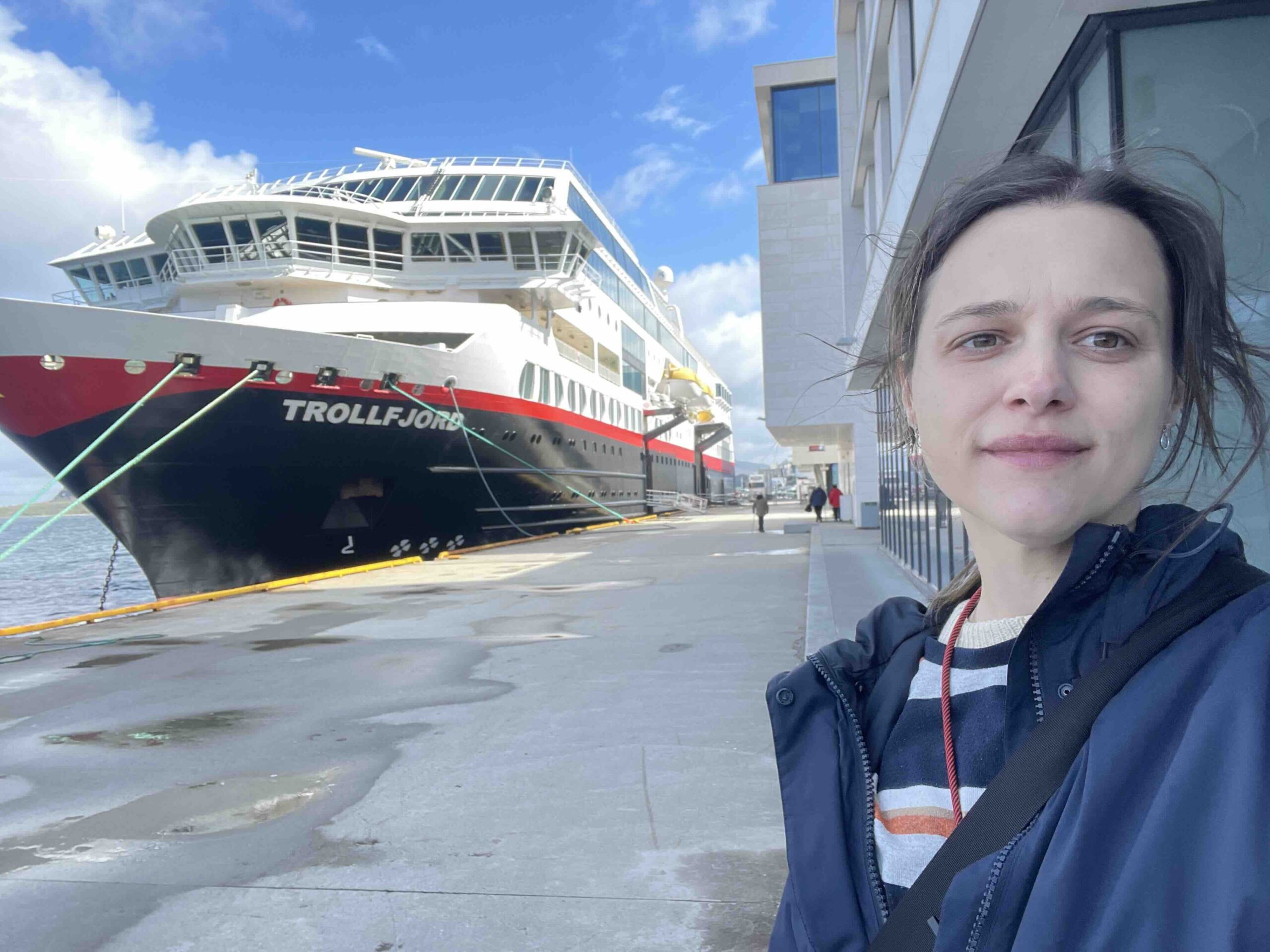
Hurtigruten vs Havila: A Coastal Ferry Comparison by a Tour Leader
The legendary Norwegian Coastal Express route from Bergen to Kirkenes has two competing ferry lines: Hurtigruten, the historic operator for more than 130 years, and Havila, the newcomer since 2021. Both offer the same spectacular 12-day voyage, calling at 34 ports along the Norwegian coast, but how do they compare in terms of rooms, onboard life, excursions, food, seating areas, and cost? Well, I’m lucky enough to have been on both many times, so I thought I’d put together a helpful guide comparing the strengths and weaknesses of Hurtigruten vs Havila, drawing on my experiences and quotes from online reviews.
Hurtigruten vs Havila comparison
Cabins and Comfort: Hurtigruten vs Havila
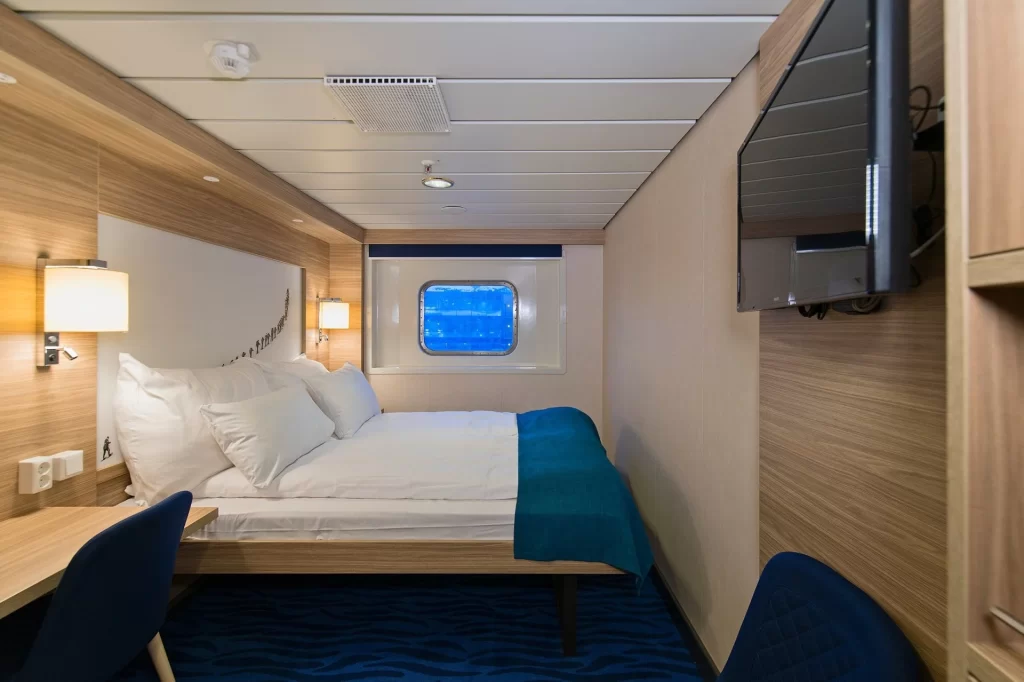
Havila’s four new ships were purpose-built with passenger comfort in mind. Even the basic inside cabins are well-appointed, and the outside cabins are noticeably roomier than Hurtigruten’s equivalents. Many cabins feature calming Scandinavian décor and practical touches, such as plenty of storage and USB charging points. Some Havila ships offer balcony cabins, whereas Hurtigruten does not. Because Havila’s fleet is brand new, noise insulation is excellent. Havila’s standard outside cabin, called “Seaview Superior,” is modern, spacious (around 16 m2), and includes a full double bed, a seating area, and a larger bathroom.
Hurtigruten’s fleet was built in the 1990s, and its cabins resemble those more than those on a ferry. Cabin sizes and styles vary more widely, but unless you opt for a suite, you won’t get sofas or spacious seating areas in your cabin. Still, most travellers find the cabins clean and functional, if unremarkable. There’s a broader range of categories on Hurtigruten, but the larger cabins can be pricier than similar ones on Havila.
Also, be mindful of location – on many Hurtigruten ships, an outdoor promenade deck encircles a mid-level deck so that people will be walking past your window. By contrast, Havila’s promenade is up on Deck 9, away from cabin windows.
Overall, if cabin size and modern comfort are priorities, Havila has the edge with larger, newer rooms, while Hurtigruten offers more budget-friendly options and greater variety.
Both lines provide basic amenities like en-suite bathrooms, bedding, hair dryers, and towels. On both ships, only higher-end cabins have kettles in the room. I recommend buying a mini travel kettle to take with you, rather than splurging on a better room just for the kettle!
Cabin Photos, Links & Amenities
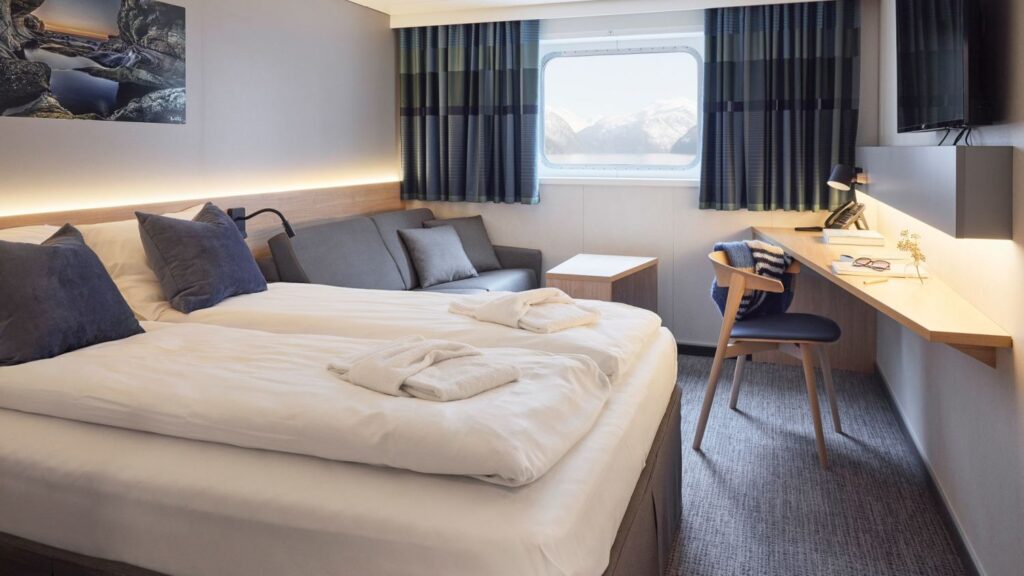
Hurtigruten
Havila
Cabin Size
10-11m2
15-16m2
Desk
Sofa
TV
Fridge
Hairdryer
Free Wifi
Kettle
Only in Arctic Superior cabins
Northern Lights Alarm
Havila’s Seaview Cabins: https://www.havilavoyages.com/the-ships/cabins/seaview
Hurtigruten’s cabin categories (note! The pictures used are from their expedition cruises, not the coastal voyage ships, but the categories are the same): https://www.hurtigruten.com/en/about-us/onboard-experience/cabins-and-suites
I recommend browsing each ship’s cabin categories separately. For this article, I used M/S Nordlys: https://www.hurtigruten.com/en-us/ships/ms-nordlys
I won’t get into comparing the suites, especially since they vary so much, but you can read about them here: https://www.havilavoyages.com/the-ships/cabins/suites
Onboard Activities & Amenities
Neither Hurtigruten nor Havila is a typical cruise ship – the scenery is the leading entertainment. Don’t expect Broadway shows or casinos on the voyage.
“If you think you are going on a conventional cruise, then stay at home because you would be disappointed… if you want a different experience, then continue” – Havilla Traveller on TripAdvisor.
In practice, life onboard is relaxed and low-key, focused on enjoying nature and culture. In the evenings, there may be an event such as a quiz or live music, but it largely depends on the crew members on board.
“There’s no kind of entertainment, so bring a nice deck of cards and a good book in addition to a tablet, says a Havilla traveller on Tripadvisor.
That said, I will say Hurtigruten’s onboard activities are better than Havila’s. While both ships have an expedition team, in my experience, Hurtigruten’s team is far more engaged, with daily lectures and additional activities. Havila, being newer, has an expedition team, but I’ve found they rarely host daily lectures or gatherings. This is also a common criticism I’ve seen in Facebook groups: one passenger wrote that over four days, they received only one lecture. On Hurtigruten, the expedition team has its own dedicated desk and section, while on Havila, they usually sit at the souvenir shop.
In my experience, this is highly crew-dependent; some crew members are super engaged and constantly host activities, while others don’t do as much. Shout out to M/S Nordnorge and M/S Richard With, which I have found to be the two most active ships for activities. The daily gatherings are excellent, and the expedition team regularly offers hikes or walks in ports. Additionally, Norway’s Coastal Kitchen is an event that occurs several times during the journey, where the chef and crew come out, and you can sample (for free) local Norwegian foods.
On Board Amenities
When it comes to amenities, both ships offer a surprising amount given their size. All Havila ships have two small gyms and a sauna, while Hurtigruten ships have one gym and a sauna. Both companies have outdoor hot tubs. Both companies have a self-service laundry room. Both companies have small gift shops selling essentially the same items. Wi-Fi is available for free from both companies, and it works well. Neither company has a kids’ club, but children are welcome on board.
Hurtigruten
Havila
Gym
Sauna
Hot Tubs
On most of the ships
Restaurants
1 main (included), 1 fine dining (extra charge), 1 bistro (extra charge), 1 cafe (extra charge)
1 main (included), 1 fine dining (extra charge), 1 cafe (extra charge).
Laundry
Panorama Lounge
Promenade Deck
Excursions on the Norwegian Coastal Route
Both Hurtigruten and Havila offer optional excursions at port stops, and they are the same. In fact, since the route and timing are identical, many excursions are essentially the same tours run by local operators, whether you sail with Havila or Hurtigruten.
The selection is impressive, but the prices are high, reflecting both the quality and cost of tourism in Norway.
Checking the list of excursions for 2026, I counted 65 Hurtigruten excursions and 66 Havila excursions. Comparing the prices, the North Cape excursion is 179 EUR per person on Hurtigruten, while on Havila the price is ‘from’ 162 EUR; they aren’t as upfront about their prices on their website – you have to go to a dedicated table, and there are multiple prices listed. Another example: A Taste of Vesterålen on Hurtigruten costs 149 EUR per person, while on Havila the price starts at 140 EUR per person. It seems Hurtigruten is slightly more expensive, but not by much.
The value of these excursions comes down to personal preference and luck with the weather. Some travellers online rave about them, but others feel the price is too high. In my experience, if you can afford it and you know it’s an excursion you really want to do, then book it. If it’s an excursion that you’re booking only because someone told you it was “the best, or if you feel you have to book it, then reconsider if you really want to do it.
Overall, excursions on Hurtigruten and Havila are entirely optional and similar in content and cost. If your budget allows and you see something that speaks to you, then book it. However, the ports are also extremely walkable, and you can visit them on your own. Get a copy of my Coastal Ferry Guidebook for self-guided walks in all the ports!
Havila’s Excursion list can be found here: https://www.havilavoyages.com/excursions
And their price list is here: https://www.havilavoyages.com/excursions/excursion-price-list
Hurtigruten’s excursions can be found here: https://www.hurtigruten.com/en/extras/excursions

Coastal Ferry Guidebook
Get a copy of my coastal ferry guidebook by clicking the link below.
Food and Dining on Hurtigruten vs Havila
Food is often a highlight on both Havila and Hurtigruten, with an emphasis on fresh, local Norwegian ingredients. You’ll sample things like Arctic char, king crab, reindeer, cloudberries, and artisan cheeses. In terms of quality, travellers on both lines frequently praise the meals as delicious.
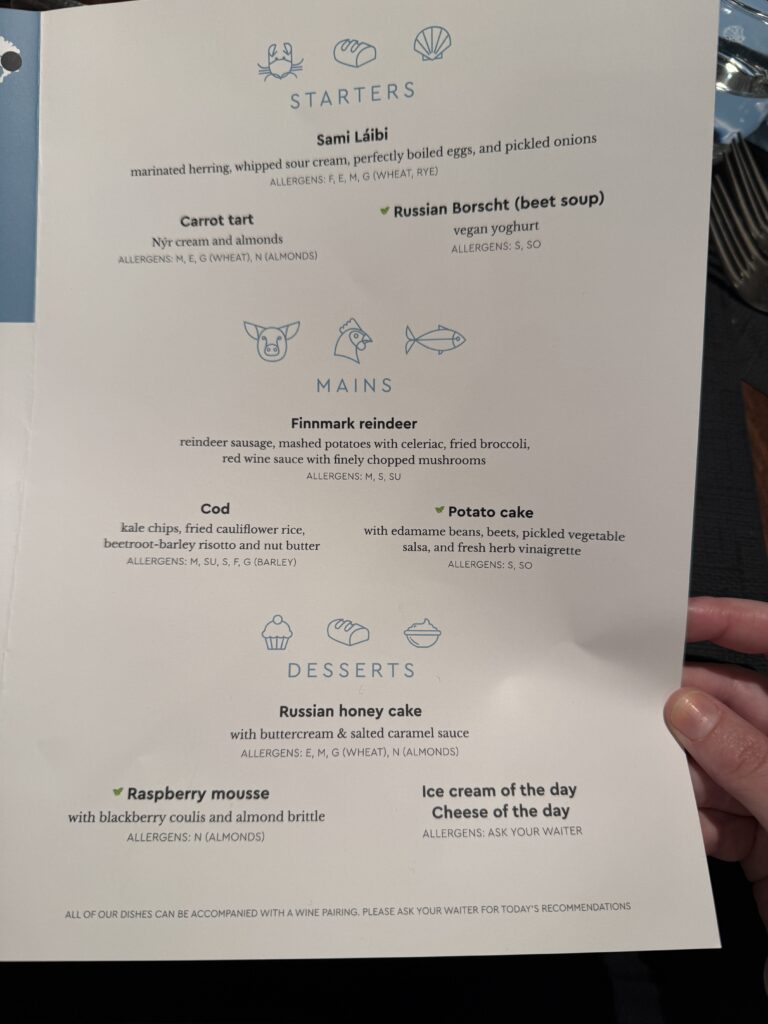
Eating on Hurtigruten
Dining format and style are where the two differ significantly. Hurtigruten sticks closer to traditional cruise dining: there’s a buffet at breakfast and lunch with open seating, and then a set three-course menu and assigned times at dinner. The buffets are excellent – they focus on locally sourced, fresh, and seasonal food – and often feature leftovers from dinner the night before, which I appreciate. The set dinners change daily, and the region of Norway constantly inspires the menu you are currently in. Each menu includes a written overview of the region’s local foods and the sources of your dinner. I absolutely love this feature!
It’s also worth noting – with each dinner menu, you choose between a meat, fish, or vegetarian option. So, for example, you can order the meat starter, fish main, and vegan dessert!
Read more about Norway’s Coastal Kitchen: https://www.hurtigruten.com/en/about-us/norways-coastal-kitchen
Read more about the restaurants: https://www.hurtigruten.com/en/about-us/norways-coastal-kitchen/coastal-restaurants
You can even view a sample of the daily menus on their website – how cool is that! – so you can see what I mean about each day promoting food of the region & where they sourced the food from. Click here to see it.
Eating on Havila
Havila, on the other hand, has a small plate dining concept. All meals on Havila are ordered from a menu and served at your table. Portion sizes are small by design, but you can order as much off the menu as you want, and it’s all included. They also only change the menus every three days, meaning if you are only doing northbound (six nights), you’ll have two menus – one for the first three days, and one for the second three days. I found this so difficult; by day 3, you are pretty sick of everything on the menu! I have no issue eating the same thing multiple times in a row when I’m at home, but when I’m travelling, I do want a little variety. They do have several options on each menu, but once you eliminate foods you don’t like, there are few choices left. It’s also frustrating to constantly have to flag down servers, who are understandably quite busy. You also have set times for breakfast, lunch, and dinner, which can be a little frustrating. Maybe I’d be different if I were travelling for vacation and not work, but what I love about Hurtigruten is being able to walk into the dining room, grab breakfast at the buffet right away, eat, and then leave – all at whatever time I wake up, or whenever I need to be ready by. For Havila, each meal takes significantly longer and can be more frustrating.
Here’s Havila’s Food Stories website: https://www.havilavoyages.com/the-ships/havila-food-stories
And here is the explanation of the four menus they have over the 12 day voyage: https://www.havilavoyages.com/the-ships/havila-food-stories/flavours-of-norway
Which is best?
For me, Hurtigruten wins hands down. The food is better, more localised, more varied, and more free.
Both lines feature an à la carte fine-dining restaurant on board. If you feel like splurging on a special dinner, the ship’s specialty restaurants have received food reviews for their cuisine. However, it’s essential to know that the main dining room is so good that you don’t need to pay extra to eat here.
One difference between the two – coffee and tea are included free of charge on Havila; there are self-service coffee stations, and they’re provided at meals. Hurtigruten, by contrast, includes only coffee and tea at breakfast and lunch; outside those times, unless you have a special loyalty card or package, you have to pay for coffee. I always bring a travel kettle and my own coffee/tea; it’s much more convenient.
Seating Areas & Scenic Viewing
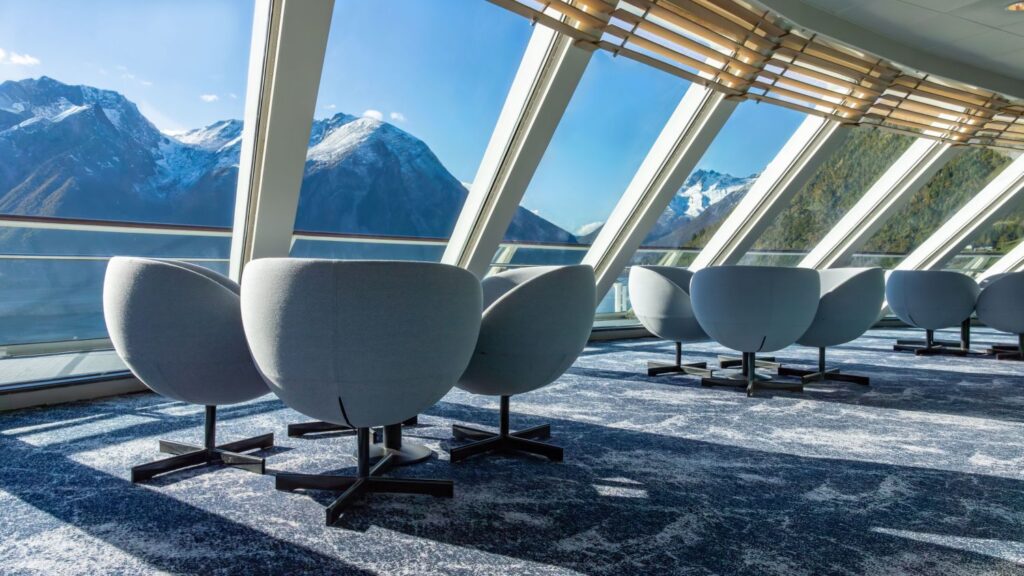
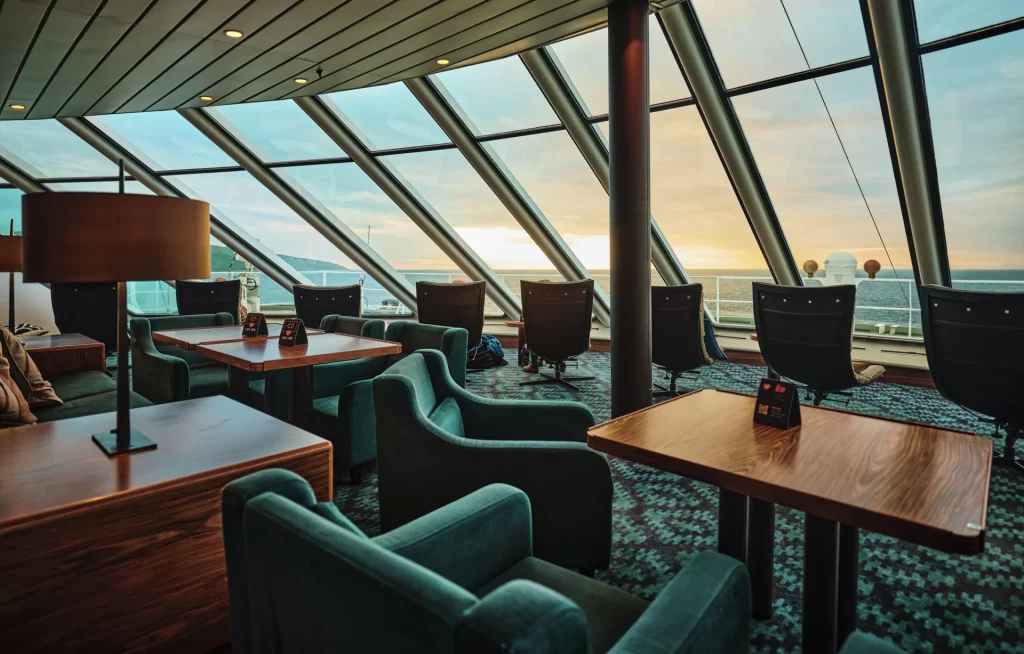
The best part of the coastal voyage is simply watching the world glide by. Both Hurtigruten and Havila offer ample lounges, decks, and seating areas for just that. However, Havila’s new ships were explicitly designed to maximise passenger space and viewing comfort. Travellers frequently remark that Havila never feels crowded. Each Havila ship features two large panorama lounges. These lounges are furnished with armchairs and sofas, and even a faux fireplace for added coziness.
Hurtigruten’s ships, while older, also have a lovely panorama lounge. There are usually plenty of seats, but on a full sailing, the prime window spots in the lounge can fill up. Hurtigruten ships also have small libraries, puzzles, and games on some vessels. While Hurtigruten’s public areas are perfectly comfortable, they arguably lack the wow factor of Havila’s ultra-modern lounges. Where Hurtigruten may have an edge is atmosphere – there’s a sense of seafaring tradition in these salons.
Out on deck, both lines allow you to soak in the scenery with ease. Hurtigruten’s ships have accessible outer decks at multiple levels, and the traditional panorama deck is on deck 5 (on the smaller vessels). And, as mentioned above, the panorama deck is outside people’s cabins. Havila’s design moved the promenade deck to the top – Deck 9 – so you can loop around away from people’s cabins.
Cost and Value: Hurtigruten vs Havila
For many, the deciding factor between Hurtigruten and Havila is price. At first glance, Havila tends to have lower fares for the same itinerary and cabin class. Hurtigruten’s prices carry a premium, partly due to its brand legacy and possibly to the higher operating costs of a larger organisation.
However, a few nuances on cost. Hurtigruten occasionally runs promotions. They also have a loyalty program that offers customers a 5% discount, which can be beneficial since they sail to many regions around the world. Havila, being new, had introductory prices that have been creeping up as the service has matured.
Also, Hurtigruten has more ships, so there is often more price variety.
Price Comparison
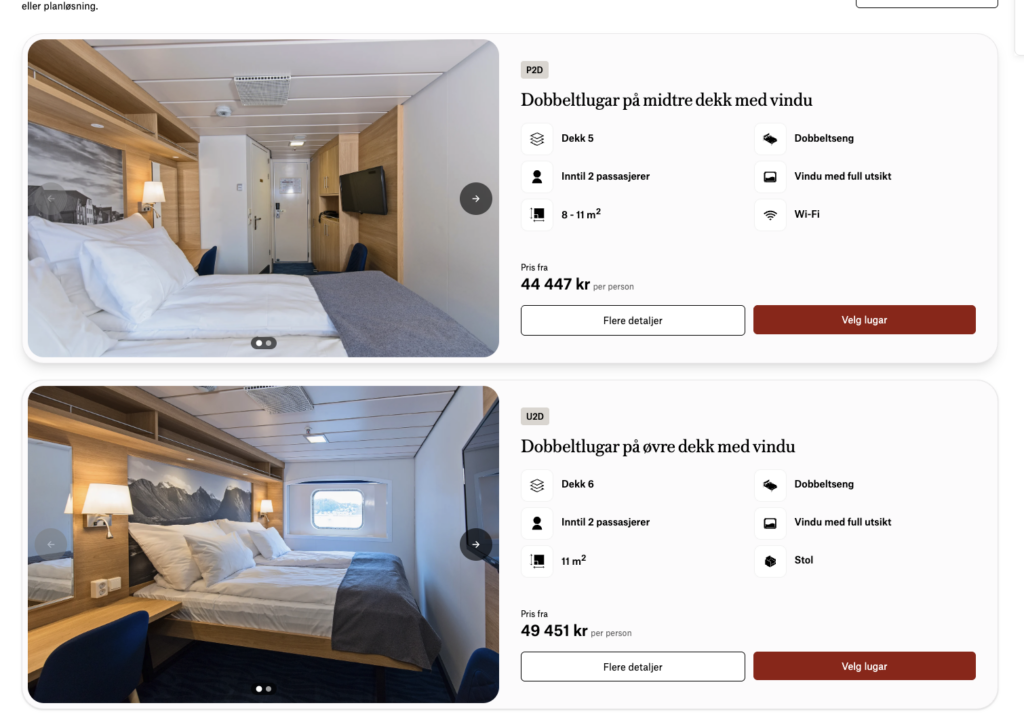
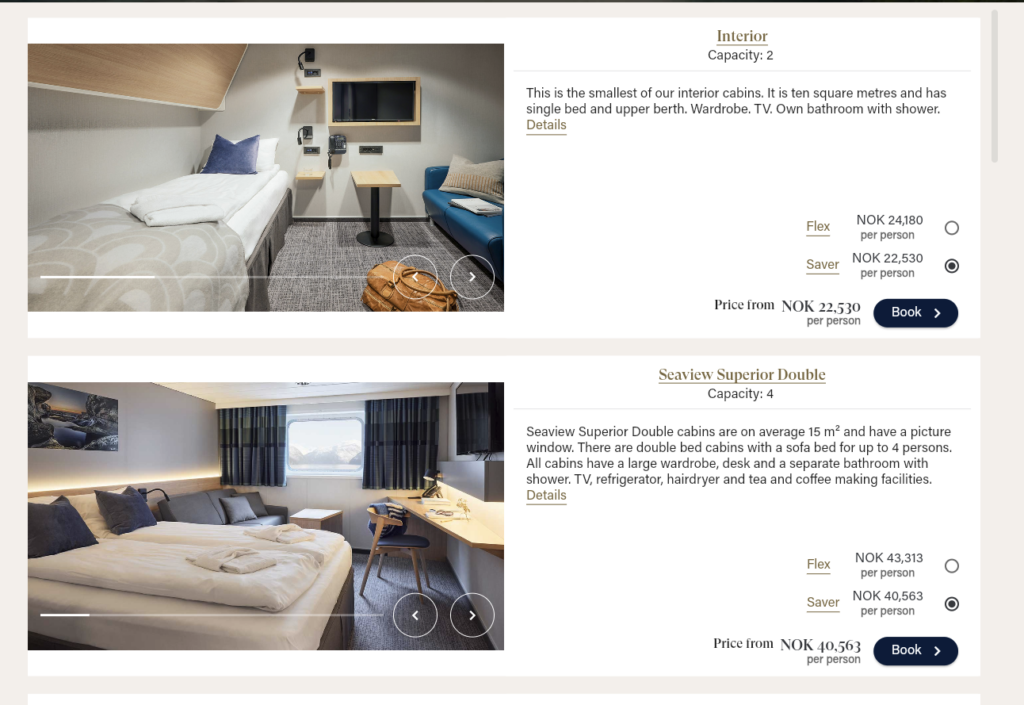
I did a test on their websites – I looked at a 12-day voyage in August 2026 (this article was written in January 2026) to get a sense of the prices.
A cabin with a double bed and a window on Hurtigruten would cost approximately 44,447 NOK per person, whereas a similar cabin on Havila would cost 40,563 NOK. An interior cabin on Havila costs around 22,000 NOK per person, while on Hurtigruten it costs 30,360 NOK. Therefore, Havila is a little cheaper overall. However, when I booked my own voyage in April and May 2025, I distinctly remember Hurtigruten being more affordable because the sale included no single supplement, and I was travelling alone.
What's Included
When evaluating cost, consider what’s included. Both lines include cabin and meals, and neither includes excursions. On board, you pay extra for beverages (aside from basic coffee/tea and water), and for extras like laundry detergent. These expenses are roughly the same on either ship – you’re dealing with Norwegian prices across the board.
Value for money is ultimately subjective. Hurtigruten loyalists might be willing to pay more for the company’s long track record or certain comforts. Havila fans point out that you get a brand-new ship and a similar experience for possibly less money. Availability may also influence your decision; Hurtigruten runs seven ships to Havila’s 4, meaning Hurtigruten offers more sailings and cabin options on any given date.
Both companies have experienced unforeseen issues. E.g., Havila’s early operations were disrupted by financing sanctions (which delayed new ships) and a sailing cancellation, while Hurtigruten experienced a notable ship breakdown that delayed a voyage. These appear to be exceptions rather than the rule. Still, it’s worth purchasing travel insurance regardless of line, as neither is immune to mechanical or weather disruptions (refund policies may leave something to be desired – one Hurtigruten guest was miffed they got only a letter of apology and no refund after a two-day delay.
In the end, both cruise lines promise an incredible journey along coastal Norway. For many travellers, the choice comes down to personal priorities: Havila’s new ships, larger cabins, and lower cost versus Hurtigruten’s choice of departures, classic ambience, and long-standing reputation.
Cancellation Protection & Booking Flexibility
Understanding your cancellation protection is vital when you’re planning a long voyage like the Norwegian coastal route – it’s a significant investment, and plans can change. Unfortunately, neither Hurtigruten nor Havila offers very generous free cancellation terms by default, and most protection comes from travel insurance you buy separately.
With Hurtigruten, deposits are usually non-refundable. Cancellation charges rise steeply the closer you get to departure, potentially reaching 100% of the fare if you cancel within a few weeks of sailing.
With Havila, if you book the cheapest fare, it is non-refundable. For Flex fare categories, you can cancel within 14 days of booking for a full refund. Like Hurtigruten, Havila requires travel insurance for all passengers. Havila’s published online terms and conditions are less transparent about deadlines and penalty percentages than Hurtigruten’s, so you need to refer to your specific fare rules at the time of booking.
Hurtigruten
Havila
Standard fare flexibility
Limited — deposits usually non-refundable, steep penalties close to departure
Depends on fare category — cheapest fares often fully non-refundable. On “Flex”, you can be refunded within 14 days of the booking being made.
Clear published cancellation schedule
Yes — cancellation fees rise over time (penalty tiers up to 100 %)
Not publicly detailed — varies by fare category
Refunds for own-fault changes close to departure
Often you lose most or all fare unless you bought a flexible option
Saver fares typically lose all; flexible categories needed for refunds
Excursion refunds if operator cancels
Yes
Yes
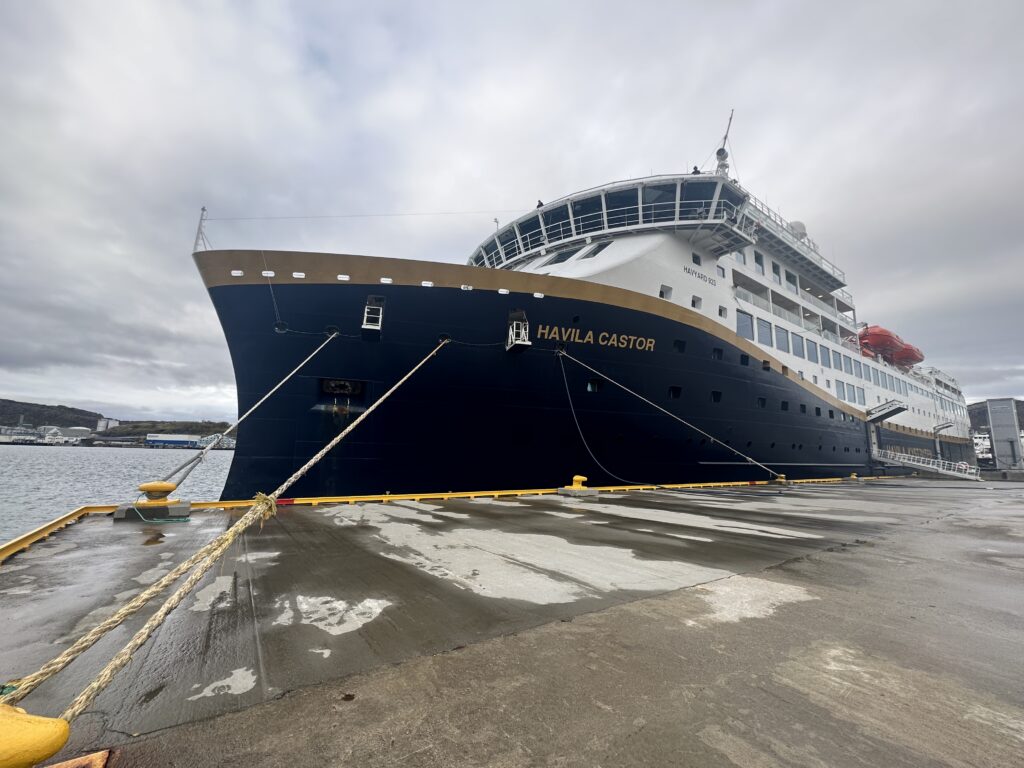
Handling Missed Ports, Route Deviations, and the "Serious Stuff"
On the Norwegian Coastal Route, missed ports and timetable changes do happen – storms, ice, harbour conditions, mechanical issues, medical evacuations, and safety directives can all force a ship to skip a port, arrive late, or alter the route. The key difference lies in how each company frames its responsibilities and the remedies you’re likely to receive.
Hurtigruten’s terms make it clear that the company/captain has broad discretion to deviate from the advertised course, call at different ports, or take any actions required for safety and compliance. They are not required to give prior notice and will not incur liability for loss/delay in those scenarios.
If the deviation is considered minor, Hurtigruten says it has no obligation to refund. If the deviation is not minor, or Hurtigruten cancels the cruise, they state they will provide a refund “commensurate” with the portion of the trip that did not take place.
Operationally, Hurtigruten also sets expectations on its disruption page:
- They’ll communicate delays and changes
- Arrange or advise on alternatives (transport, meals, accommodation) “when appropriate”
- Where key parts can’t be fulfilled, they may offer equivalent alternatives, a refund/price reduction, or compensation, depending on the circumstances.
Hurtigruten’s written approach is “we can change the plan for safety/operations; if it’s big enough to be non-minor, you may get a proportional refund. The grey area is what counts as minor vs not minor in a real case.
Having been on Hurtigruten when issues have arisen, I’ve found that nothing is handled perfectly, but I have always felt they’ll do their best to offer alternatives if necessary. Deviations are often announced at the last minute, but that’s because they only decide on the deviations at the last minute, after attempts and calculations have been made.
In instances where we’ve had significant deviations, such as being unable to sail to Kirkenes, Hurtigruten hires buses and provides transportation to Kirkenes so guests can make their flight.
Overall, because Hurtigruten is better established, it has better systems in place for handling issues.
Havila’s current travel terms are structured around whether the trip becomes “deficient. If things change before departure, Havila says you may be able to cancel if the changes amount to a significant deficiency/major disadvantage, and they may offer an alternative or provide a full refund if no alternative is offered.
If problems happen after departure, Havila lists a ladder of options:
- Remedy
- Alternative travel services
- Price reduction for the duration of the deficiency
- Termination with a refund for undelivered services
- Compensation for financial loss in some instances
For “serious” interruptions (e.g., the trip must be cut short), Havila also says they will arrange transport back to the agreed-upon departure port at no cost and with minimal inconvenience. If they fail to arrange timely repatriation and you must do it yourself, they’ll cover reasonable additional expenses.
My tips:
- Be patient. It takes time for alternative plans to be made, and the staff are working hard to fix things
- Check things yourself using Windy, MarineTraffic, and FlightRadar24.
- Assume that the weather will always reshuffle plans.
- Don’t schedule flights for the day of your voyage. Add a buffer, especially in winter
- Keep receipts for disruption-related costs and report issues promptly
- Get travel insurance
Final Thoughts - Which Ship is Best?
Both Hurtigruten and Havila offer a memorable way to experience Norway’s coastline, each with its own flavour. Hurtigruten carries the heritage of the Coastal Express – you feel like a part of their maritime history on their ships, and you might appreciate the little touches of tradition. Havila brings innovation – a greener, quieter ship with a fresh feel and a slight twist on the usual cruise conventions. Many travellers who have tried both come away impressed by how similar the core experience is. The differences – a bigger cabin here, a buffet there, a few dollars saved or spent – are essential but not trip-defining.
Whichever ship you choose, prepare for a unique style of travel. This isn’t a conventional cruise but a hybrid cruise-ferry voyage. Embrace the differences: the boat will stop frequently (sometimes briefly) to deliver cargo and local passengers; your fellow travellers will include not just tourists but also Norwegians using the ship to get from town to town. The atmosphere is relaxed, not luxury-liner opulent. You’re paying a premium, yes, but for an experience that many call priceless – watching the northern lights dance over a snow-dusted harbour, gliding through narrow fjords at dawn, or sipping a hot drink as charming fishing villages pass by. Both Hurtigruten and Havila excel at delivering these moments.
So, which ship is best? – Well, it depends – what’s best for you? Do you prefer having a large cabin, or is the overall onboard experience best? Is price a concern, or are you ready for a splurge? Different people prefer different ships, and it really comes down to personal preference.